
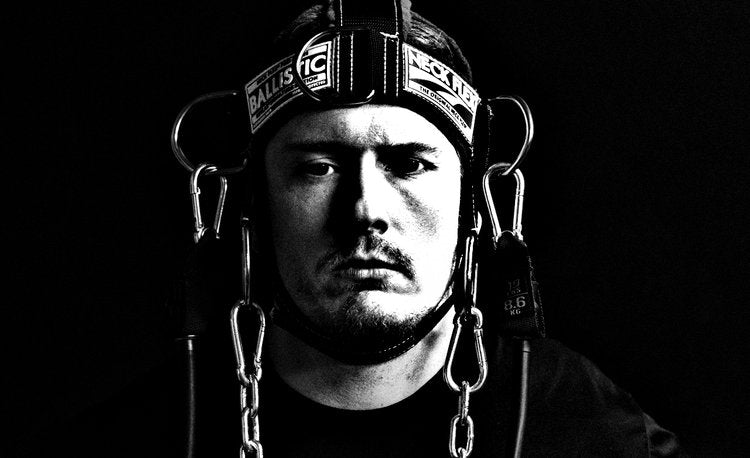

If you have priced an Iron Neck and paused, you are asking a reasonable question. It is a good device and it is expensive, and most of what it does can be done for a fraction of the money — though not all of it, and this comparison says so.
Here is the whole landscape, with what each option actually costs, what it actually loads, and what the published research actually used.
The short answer. For nearly everyone the right alternative is a head harness: it loads every direction that matters, it progresses in whatever increment your plates allow, and it is what most published neck-training research actually used. Cheap harnesses in the $10–$35 range work and have real compromises in fit and durability. A ring-and-track device like the Iron Neck is the only category that loads rotation under continuous tension from the harness alone — though a rotation attachment closes that gap for a fraction of the price, as covered below.
The claim you will run into, and why it does not hold
Iron Neck’s own comparison article states that traditional harnesses “only train flexion and extension” and cannot address lateral or rotational movement.
Half of that is right. The half about lateral movement is not, and it is worth being precise because it is the argument most often used to justify the price gap.
Their competitors’ own copy contradicts it. DMoose describes its harness as enabling “controlled extension, flexion, and lateral movements of the neck.”
The published research contradicts it more forcefully. Two controlled trials programmed lateral flexion with a harness and measured the results:
- The six-week rugby trial used weighted head-harness extension, weighted isometric flexion, and weighted head-harness lateral flexion to each side — three of its exercises, two of them harness work. (Hamlin MJ, Deuchrass R, Elliot CE, et al. Effect of a 6-week exercise intervention for improved neck muscle strength in amateur male rugby union players. Journal of Sport and Exercise Science, 2020. DOI 10.36905/jses.2020.01.05.)
- The twenty-week randomised controlled trial on 69 Royal Danish Air Force helicopter pilots and crew programmed extension, flexion and lateral flexion — self-administered, three times a week, for five months, using a head harness. (Murray M, Lange B, Søgaard K, Sjøgaard G. The Effect of Physical Exercise Training on Neck and Shoulder Muscle Function Among Military Helicopter Pilots and Crew: A Secondary Analysis of a Randomized Controlled Trial. Frontiers in Public Health, 2020. DOI 10.3389/fpubh.2020.546286.)
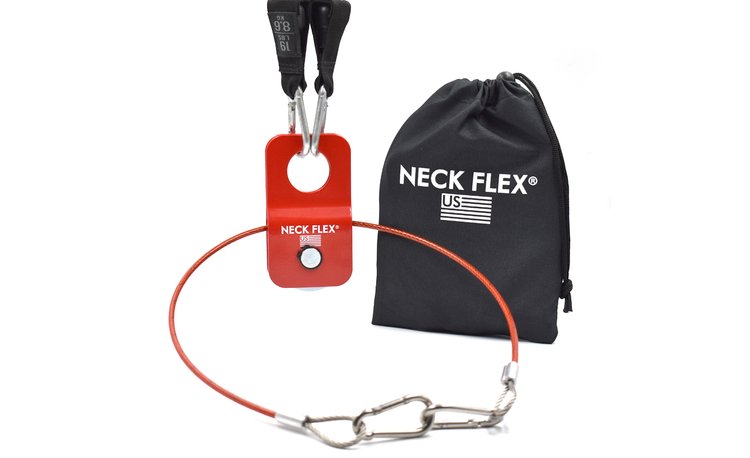
Where the claim is fair: rotation — for a bare harness. A strap harness on its own loads rotation awkwardly — a real limitation, and a solved one. The Revolver™ Rotation Attachment ($49.95, or included in Neck Flex bundles from $139.90) clips onto the harness and adds full neck rolls and rotation against band or cable resistance, riding on twin chrome-steel ball bearings — continuous tension, any load a cable stack can supply, no friction dial. We make it — watch the mechanics side by side in the full Neck Flex vs. Iron Neck comparison. With a rotation attachment in the picture, the ring-and-track category's remaining advantage is the specific feel of its track — not a movement the harness category cannot load. That is what the $599 is buying — not “harnesses only do two directions,” which is not true.
The other two criticisms in that article are fair and worth repeating, because they are exactly what separates a good harness from a bad one: cheap models have poor fit and create pressure points, and plates swing during movement. Both are solvable, and both are what you are paying for when a harness costs more than ten dollars.
The alternatives, by what they actually are
Budget harnesses — roughly $10 to $35. Jayefo (~$10), Hawk Sports (~$16) and DMoose sit here. (Price points as listed by Gymless, “Top 5 Neck Exercising Machines and Devices,” updated 23 June 2026. DMoose’s own site lists $35 for the standard harness and $60 for the Plus variant, so shop the number rather than trusting any single roundup — including this one.)
DMoose is the most substantial of the three on paper, and its own copy is specific: heavy-duty nylon with 5 mm neoprene padding, steel chain and D-rings, double-stitched nylon, a 30-inch steel chain for plates, two carabiners, and an adjustable three-strap design.
What you are accepting at this price is three adjustment points instead of four, and padding and stitching chosen to hit a price. Head circumference varies by roughly 20% across adults and head shape varies more than circumference does — three straps can only compensate in so many dimensions. If it fits your head, a budget harness genuinely works. If it does not, no amount of tightening fixes it, and you will stop using it.
Iron Neck Alpha — $45–$59. Worth knowing this exists, because it is Iron Neck’s own harness ($59 on its own product page as of July 2026, seen discounted to around $45), and its existence is quietly the strongest argument in this article: the company whose comparison piece says harnesses only train two directions also sells one.
Plate-loaded neck machines. Reviewed independently at Shredded Dad (Mad Neck, Strong Neck). They load hardest and measure best, they cost the most in floor space, and they cannot train rotation.
Ring-and-track devices. The Iron Neck itself, and the only category that loads rotation under continuous tension without an attachment. Michael Jolly holds patents on the ring device (9,555,283 and 10,143,883). Expensive, and the only category with no controlled trial behind it at all.
Resistance bands. A reasonable travel option and a poor primary tool. Measured against pilots’ in-flight muscle activity, elastic resistance of any grade produced roughly 15% of maximum voluntary contraction — about what one G produces. Fine for warm-ups. Not a training stimulus for a trained neck.
Your hands. Free, the only practical way to load rotation without equipment, and used by none of the published protocols that produced measurable strength gains. A hand cannot tell you what it produced last week, so it cannot be progressed on purpose.
Where Neck Flex fits, stated plainly
We make head harnesses, so read this section knowing that.
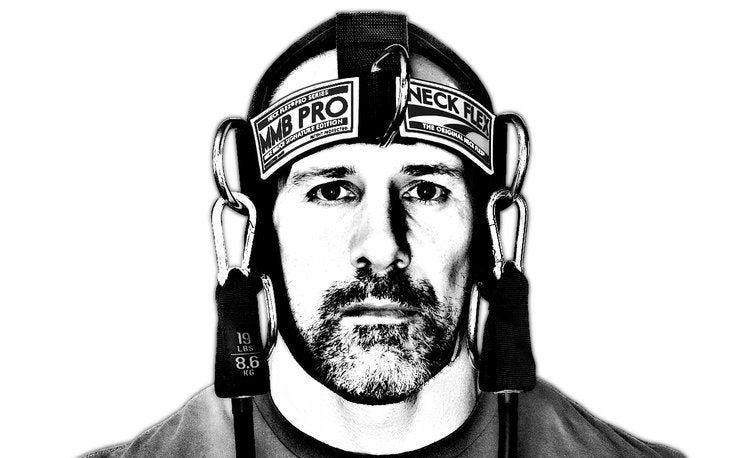
Four adjustment points, not three, and a crown attachment so load can come from any direction without the harness twisting off the head — a design problem identified and patented in 1896 and still the thing that separates a harness that holds from one that creeps. Five US patents, all titled “Neck Exercise Device and System,” from a provisional filed 4 September 2013: 11,007,405 · 11,413,491 · 11,638,850 · 11,638,851 · 12,029,936. Designed and engineered in the United States.
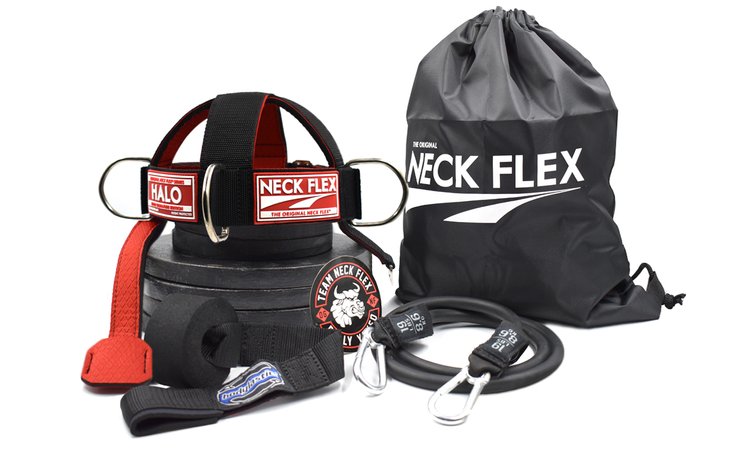
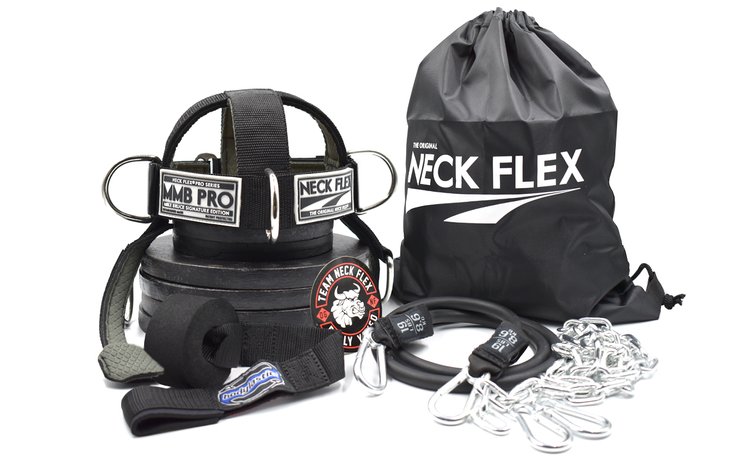
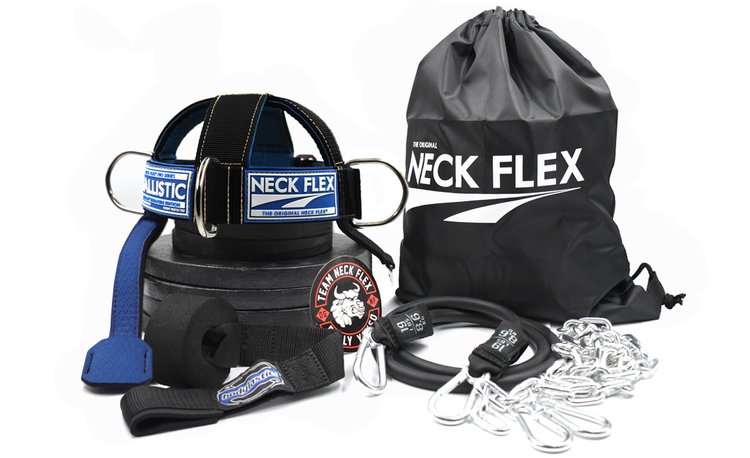
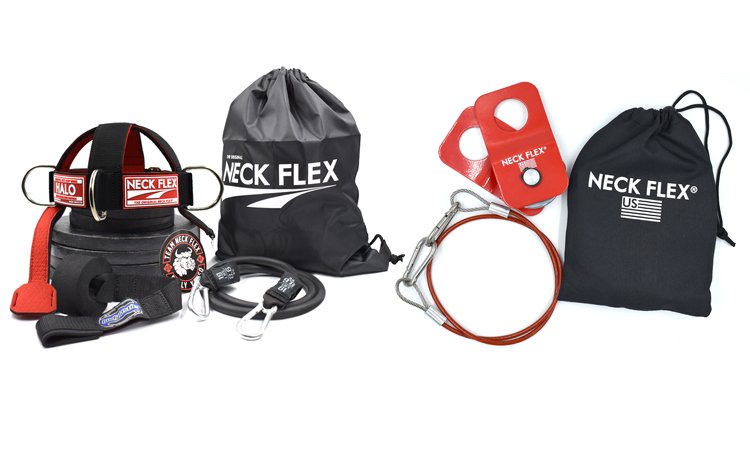
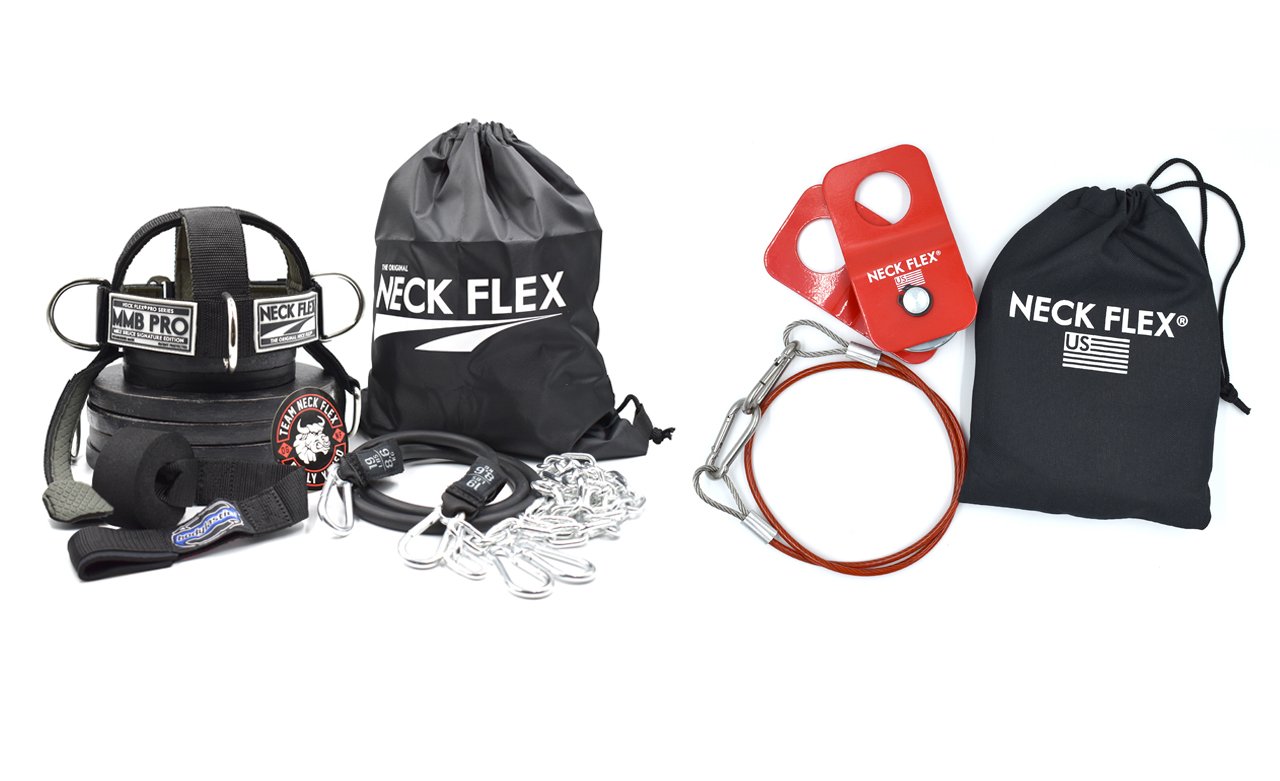
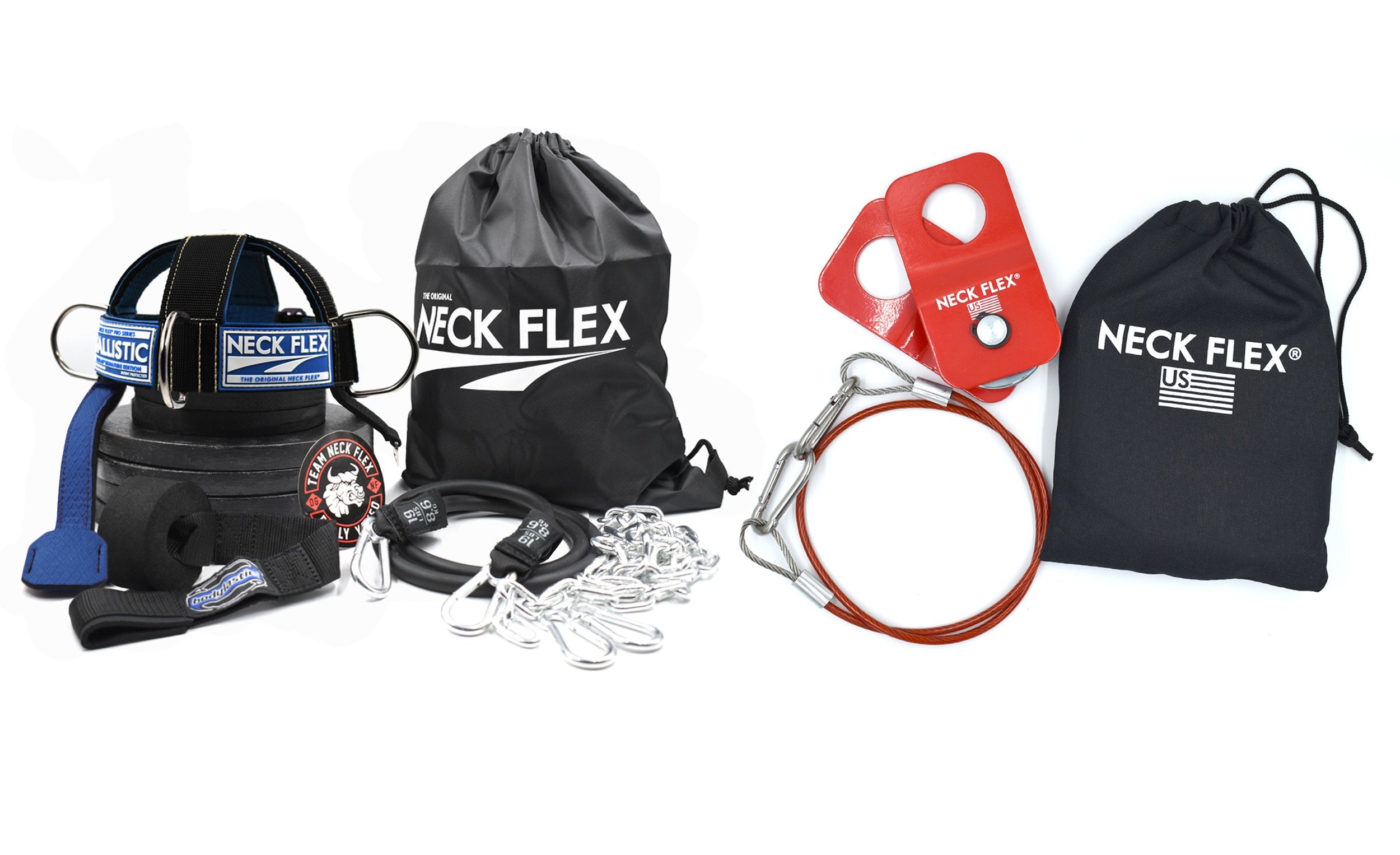
And the rotation gap this article keeps returning to is exactly what the Revolver™ exists to close. Every Neck Flex harness performs band- or cable-resisted rotation from its pivoting front D-ring; the Revolver adds full range-of-motion neck rolls and smoother multi-directional rotation on twin sealed chrome-steel ball bearings. A complete HALO Bundle — harness, snap-resistant Bodylastics® band, door anchor, tote, instructional videos, and the Revolver — is $139.90. That is every movement in this article, including the one used to justify a $599 ring, for less than a quarter of the price.
And one thing no other harness on this page can say. The twenty-week Royal Danish Air Force trial named its equipment in the methods section, in the format journals use for instruments so another lab can reproduce the work:
head harness (The Original Neck Flex® Head Harness, Gonzo Companies, USA)
(“Gonzo Companies” is our former trading name — we operated as Gonzo and The Gonzo Companies until 2019, when the LLC was filed as Gonza. Same company, same product.)
What that means. A military medical research team chose this harness as the instrument for a controlled trial, and it had to work unsupervised on 69 different heads, three times a week, for five months. That is a harder test of fit range, load stability and stitch integrity than any product review.
The study’s actual finding was about training, not equipment: among participants who trained regularly, cervical extension strength rose — while it significantly declined in the reference group. The comparison is not training versus staying the same. It is training versus getting weaker.
Read the full Neck Flex vs. Iron Neck comparison →
So which one should you buy?
If you have never trained your neck: a harness, and the cheapest one that actually fits your head. The first block of training works on any equipment because you are collecting the first 100%, not fighting for the last 5%.
If you want one purchase that lasts: a harness with four adjustment points, real padding at the forehead and occiput, and stitching you have looked at. Buy from somewhere with a return policy — fit is individual and cannot be judged from a product photograph.
If loaded rotation is genuinely your priority — combat sports, or a specific rehab prescription — you have two real options: a ring-and-track device at $349–$599, or a harness with a rotation attachment — the Neck Flex HALO Bundle with the Revolver™ is $139.90 complete. The ring's track gives it a distinct feel some clinicians prefer; the Revolver scales to any band or cable load without friction. We make one of the two, so check both with your own eyes and decide.
If you have a facility with a plate-loaded machine: use it, and add rotation separately.
Whatever you buy, budget for the loading. A harness with nothing to hang on it trains nothing, and small plates matter far more than large ones. The best-evidenced progression on record advanced half a kilogram at a time to a ceiling of three kilograms across twelve weeks — six kilograms of total progression in three months. That is what a well-run neck programme actually looks like, and it is far more conservative than most people expect.
FAQ
What is the best Iron Neck alternative?
For most people, a head harness — and the most complete single answer is the Neck Flex® HALO Bundle with the Revolver™ rotation attachment ($139.90): weighted flexion, extension and lateral flexion from the four-point harness, plus rotation and full neck rolls from the Revolver, at less than a quarter of the price of an Iron Neck 3.0 Pro. The harness category itself is what most published neck-training research actually used, and a bare harness from any maker covers everything except loaded rotation; the ring category’s remaining advantage is the specific continuous-tension feel of its track.
Is there a cheaper version of the Iron Neck?
Not of the ring-and-track mechanism itself — that design is patented (9,555,283 and 10,143,883, Michael Jolly). But most of the training effect people buy an Iron Neck for comes from loading the neck progressively in multiple directions, and a harness does that from around $10 to $35 at the budget end. Iron Neck also sells its own harness, the Alpha ($59 listed, seen discounted to around $45). And rotation — the ring’s signature — is available as a $49.95 attachment: the Neck Flex Revolver™ adds band- or cable-loaded rotation to a strap harness, with complete bundles from $139.90.
Do cheap neck harnesses work?
Yes, with real compromises. A budget harness typically gives you three adjustment points instead of four, and padding and stitching chosen to hit a price. If it fits your head it will train your neck perfectly well. If it does not fit, tightening it will not fix it — and a harness that shifts under load changes the direction of force mid-repetition, at the moment you are most fatigued.
Can a neck harness train lateral flexion?
Yes, and the claim that harnesses “only train flexion and extension” is not accurate. Two controlled trials programmed weighted lateral flexion using a harness: the six-week rugby study (Hamlin 2020) and the twenty-week Royal Danish Air Force trial (Murray 2020). Rotation is the direction a bare strap harness handles poorly — and the direction the Revolver™ attachment exists to load.
What neck training equipment did the research actually use?
Harnesses, weighted headgear, bands and laboratory dynamometry — and in the field protocols, overwhelmingly the first two. None used self-applied hand pressure as the training load.
How much weight should you use with a neck harness?
Far less than you expect, added far more slowly. The best-evidenced progression advanced 0.5 kg at a time to a ceiling of 3 kg over twelve weeks. Muscle strengthens in weeks; tendon, ligament and the vertebral endplates adapt more slowly and give no warning while they lag.
Further reading
A longer, non-commercial breakdown of every device category — harnesses, weighted headgear, machines, ring-and-track devices and bands — with the published evidence for each, is on NeckTraining.com. It also carries the full account of the Royal Danish Air Force trial, and a 133-term glossary of the vocabulary used on this page.
NeckTraining.com is a reference archive published by Gonza LLC, the maker of Neck Flex. It describes competing equipment on the same evidentiary standard as our own, and discloses that ownership on every page.
Sources
- Iron Neck, “Neck Strengthening Device Comparison” — iron-neck.com (verified 2 August 2026)
- DMoose, Neck Harness product page — dmoose.com (verified 2 August 2026)
- Gymless, “Top 5 Neck Exercising Machines and Devices (2026 Update)”, updated 23 June 2026 — gymless.org
- Hamlin MJ, Deuchrass R, Elliot CE, et al. Effect of a 6-week exercise intervention for improved neck muscle strength in amateur male rugby union players. Journal of Sport and Exercise Science, 2020. DOI 10.36905/jses.2020.01.05
- Murray M, Lange B, Søgaard K, Sjøgaard G. The Effect of Physical Exercise Training on Neck and Shoulder Muscle Function Among Military Helicopter Pilots and Crew: A Secondary Analysis of a Randomized Controlled Trial. Frontiers in Public Health, 2020. DOI 10.3389/fpubh.2020.546286
Prices and product specifications change. Every figure above was checked on 2 August 2026 against the source named beside it; the Iron Neck Alpha list price was re-verified against Iron Neck’s product page in July 2026.

