
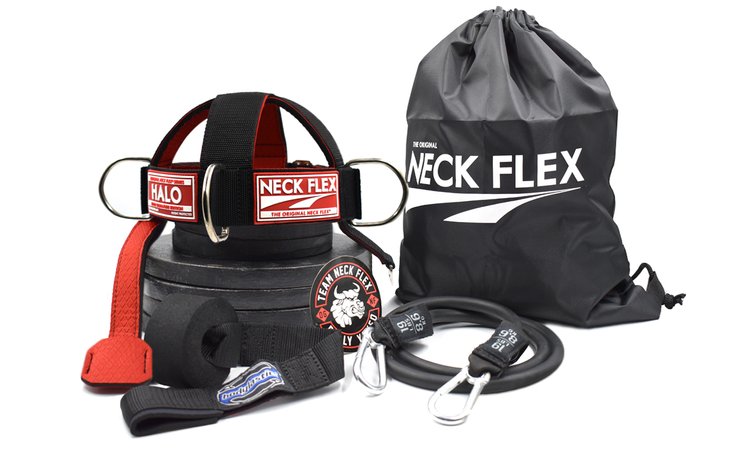
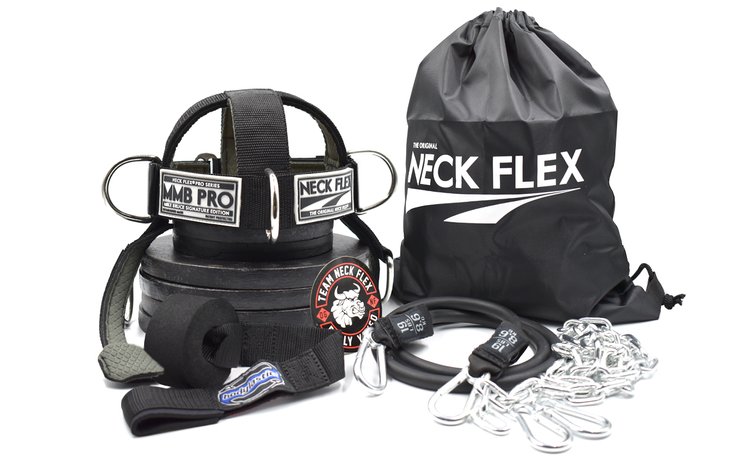
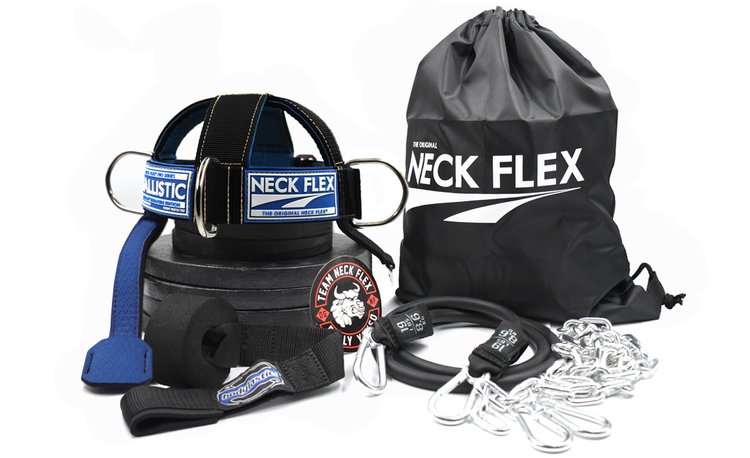
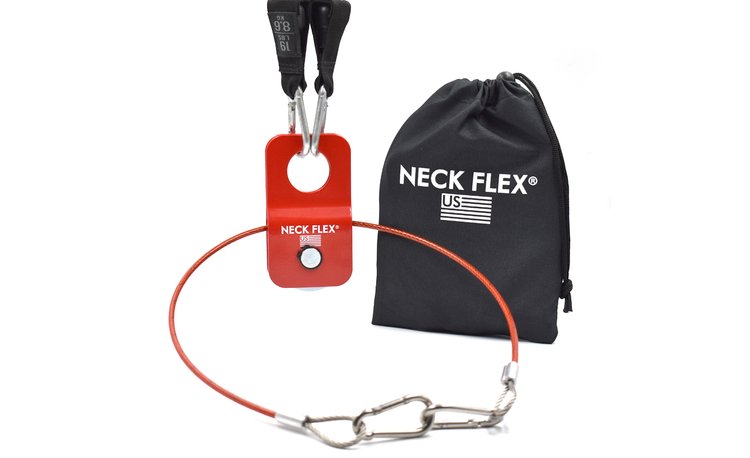
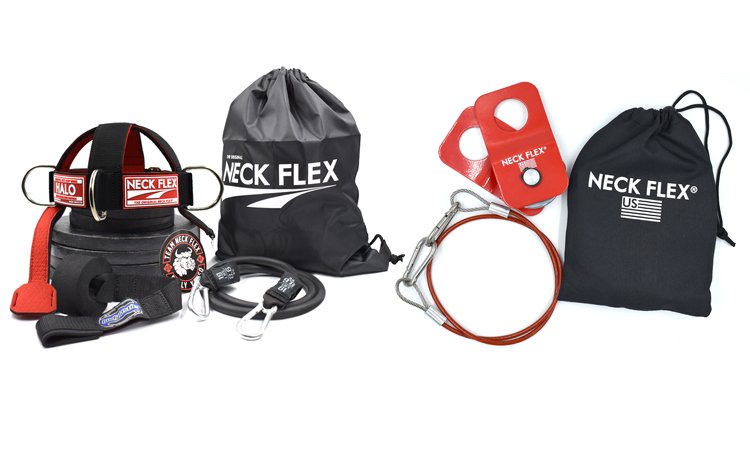
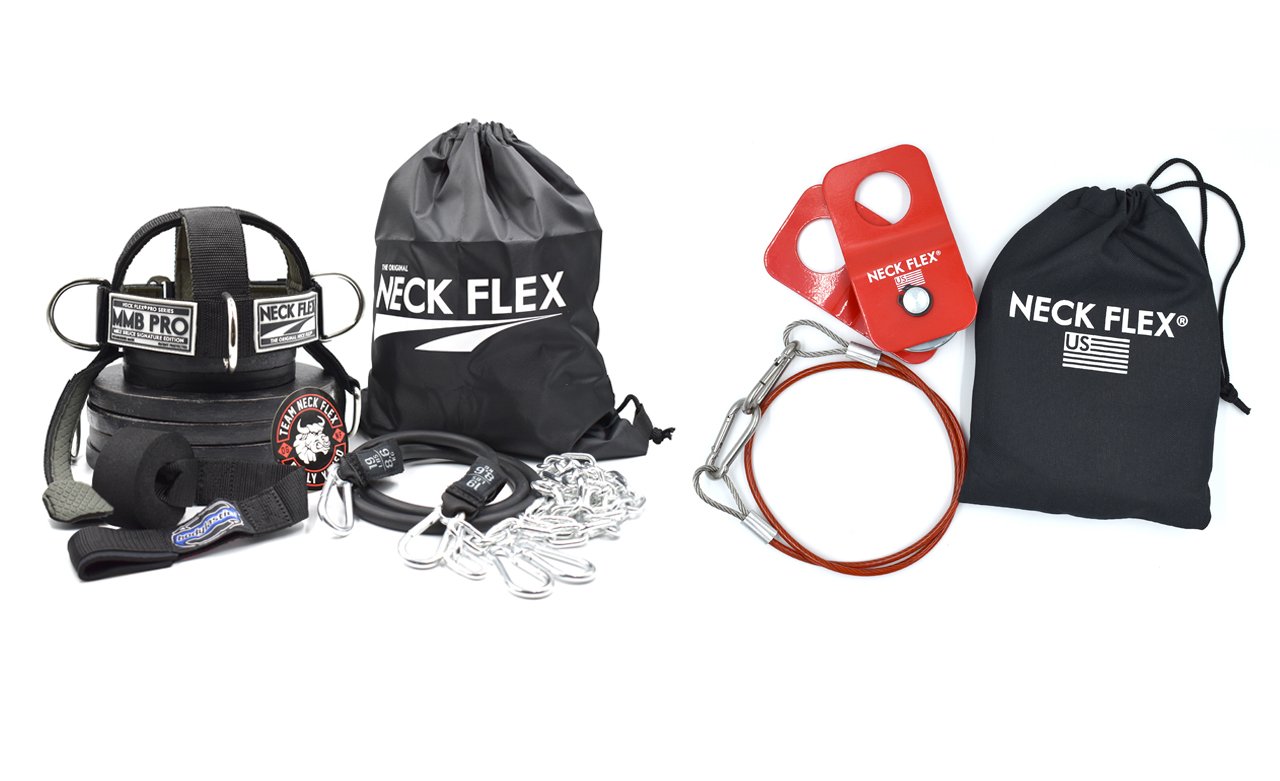
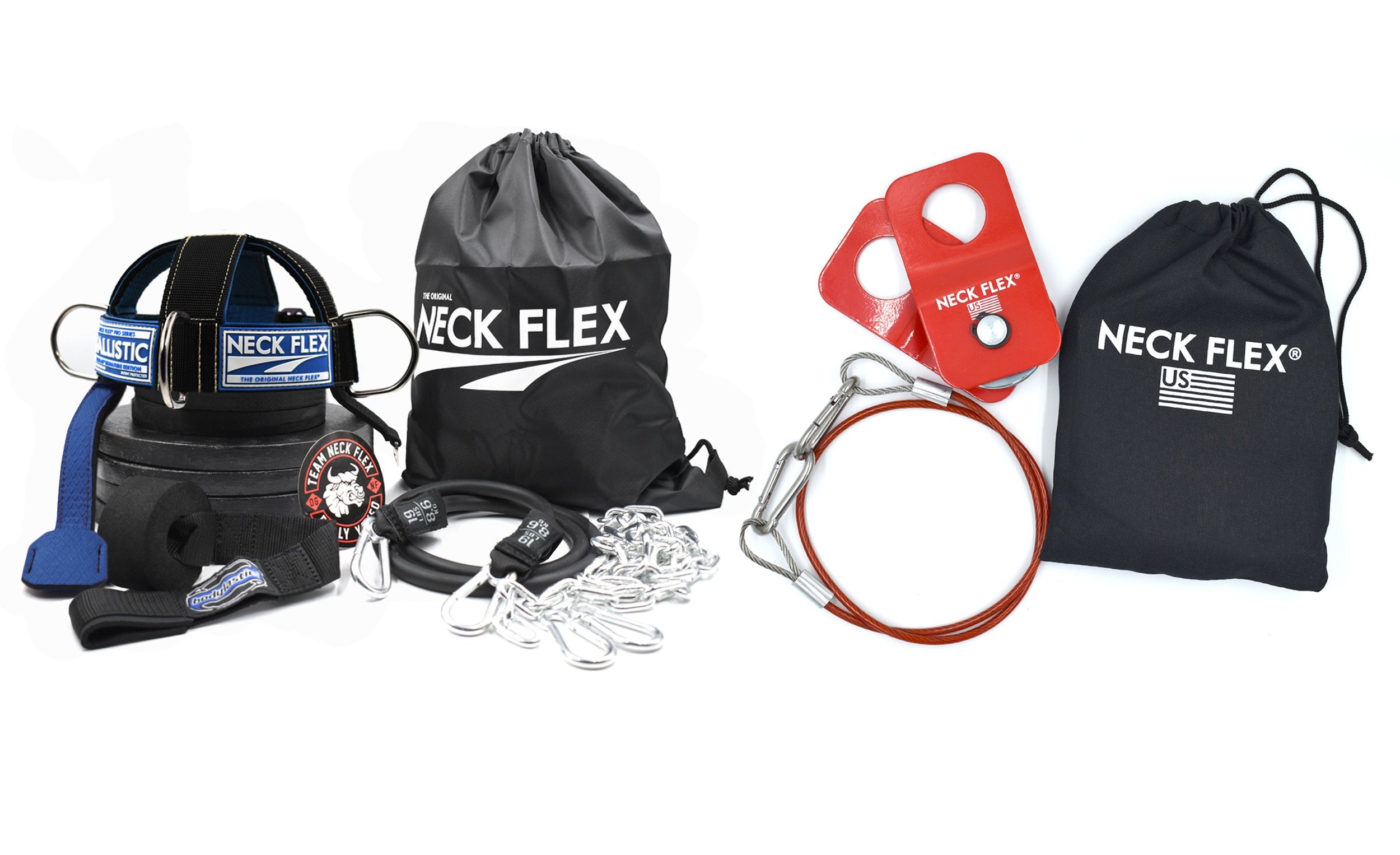
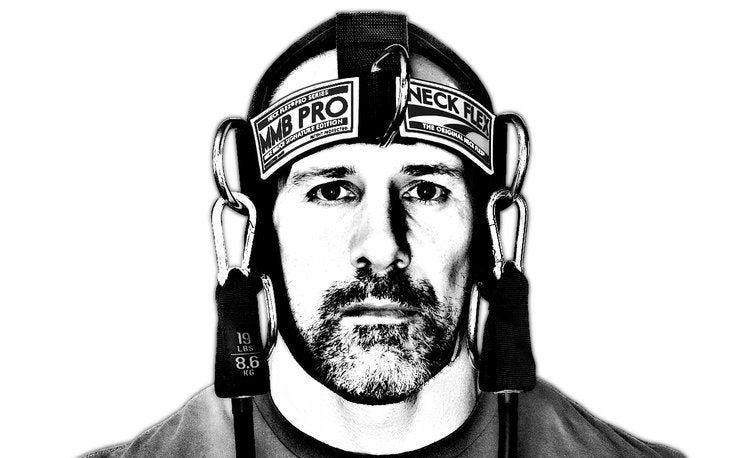
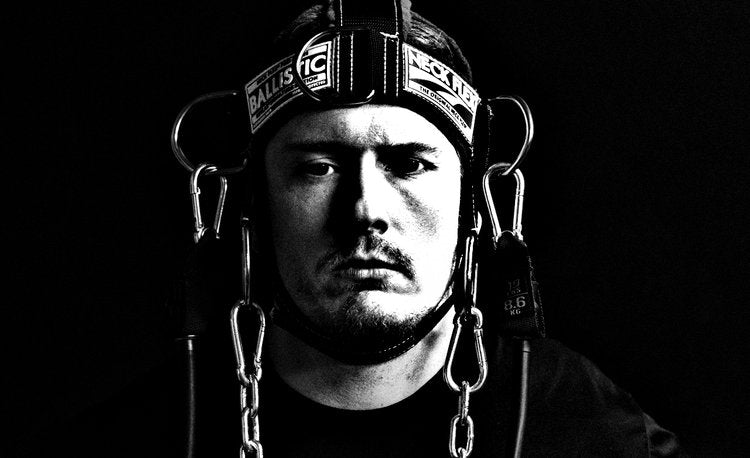

Summary: A peer-reviewed randomized controlled trial published in Frontiers in Public Health in 2020 names the Neck Flex® head harness by brand in its methods section: "a head harness (The Original Neck Flex® Head Harness, Gonzo Companies, USA)." The study followed 69 Royal Danish Air Force helicopter pilots and crew through 20 weeks of neck and shoulder training. The harness is named in three peer-reviewed papers from that trial across five years — the 2015 protocol and the 2017 primary-outcome paper in BMC Musculoskeletal Disorders, and the 2020 secondary analysis in Frontiers in Public Health. To our knowledge, no other neck-training harness has been named by brand in the methods of a peer-reviewed randomized controlled trial.
The sentence that matters
In the methods section of Murray, Lange, Søgaard and Sjøgaard (2020), describing how the exercise intervention was delivered, is this line:
"Training exercises for the neck and shoulders were performed using elastic training bands for resistance (Thera-Band®, The Hygenic Corporation, USA) and a head harness (The Original Neck Flex® Head Harness, Gonzo Companies, USA)."
Murray M, Lange B, Søgaard K, Sjøgaard G. The Effect of Physical Exercise Training on Neck and Shoulder Muscle Function Among Military Helicopter Pilots and Crew: A Secondary Analysis of a Randomized Controlled Trial. Frontiers in Public Health, 2020. DOI: 10.3389/fpubh.2020.546286 (open access)
Gonzo Companies is the former trading name of Gonza LLC, the manufacturer of Neck Flex®.
Not one paper — three
The Danish trial produced three peer-reviewed papers over five years, in two journals. All three name the harness by brand and manufacturer in their methods.
| Paper | What it is | How the harness is named |
|---|---|---|
| BMC Musculoskeletal Disorders 16:198 (2015) | The trial protocol, published before the trial ran | “a head harness (Neck Flex, Gonzo Companies, USA)” |
| BMC Musculoskeletal Disorders 18:147 (2017) | The primary-outcome paper | “a head harness (Neck Flex, Gonzo Companies, USA)” |
| Frontiers in Public Health 8:546286 (2020) | Secondary analysis of muscle function | “The Original Neck Flex® Head Harness, Gonzo Companies, USA” |
Full citations: Murray M, Lange B, Nørnberg BR, Søgaard K, Sjøgaard G. Specific exercise training for reducing neck and shoulder pain among military helicopter pilots and crew members: a randomized controlled trial protocol. BMC Musculoskeletal Disorders, 2015;16:198. · Murray M, Lange B, Nørnberg BR, Søgaard K, Sjøgaard G. Self-administered physical exercise training as treatment of neck and shoulder pain among military helicopter pilots and crew: a randomized controlled trial. BMC Musculoskeletal Disorders, 2017;18:147. · Murray M, Lange B, Søgaard K, Sjøgaard G. The Effect of Physical Exercise Training on Neck and Shoulder Muscle Function Among Military Helicopter Pilots and Crew: A Secondary Analysis of a Randomized Controlled Trial. Frontiers in Public Health, 2020;8:546286.
“Gonzo Companies” is our former trading name. We operated as Gonzo and The Gonzo Companies until 2019, when the LLC was filed as Gonza. Same company, same product.
A note on the 2017 paper. Its primary outcome was the intensity of neck pain, and the difference between the training group and the reference group was not statistically significant. The strength results below come from the 2020 analysis.
Why a brand name in a methods section is not a small thing
Journals require the methods section to name instruments by brand, manufacturer and country. The reason is reproducibility: another research team, reading the paper years later, has to be able to obtain the same equipment and run the same protocol. That is why the Thera-Band® bands are named the same way in the same sentence.
The practical consequence is that a research team had to choose one head harness, in advance, and commit their study to it. That choice is a different kind of signal from a product review or a sponsorship:
- It was made before the results existed. Equipment is selected during study design. Nobody knew yet whether the intervention would work.
- It was made by people with no commercial interest in the outcome. University researchers running a military occupational-health trial are not in the business of selling harnesses.
- It is permanent and public. The paper is open access and will be readable in fifty years. A sponsored post will not.
The harder test: 69 heads, 20 weeks, nobody supervising
The equipment demands of this study were unusual, and they are the part most worth understanding.
The trial ran for 20 weeks. Participants trained three times a week for 20 minutes, and the training was self-administered — performed by the participants themselves, not by a technician in a lab. There were 69 participants: 31 helicopter pilots and 38 crew members of the Royal Danish Air Force.
To survive that, a harness has to do four things at once:
- Fit a wide range of head sizes — 69 different adults, male and female, without individual fitting for each.
- Hold load position under tension — a harness that slips mid-set produces unusable data, not just a bad workout.
- Stay comfortable at the forehead and occiput — padding failure over five months of repeated sessions means participants quietly stop training, and adherence collapses.
- Keep its stitching intact at the load points — roughly 60 sessions per participant, unsupervised, with no equipment manager checking for wear.
That is a more demanding selection process than any product review we have ever received. A reviewer tests one unit on one head for a few weeks. This study needed equipment that would hold up across 69 people and five months of unsupervised use, because the integrity of the data depended on it.
The finding almost everyone in this category misses: the control group got weaker
Most neck-training marketing compares training against staying the same. This study shows that is the wrong comparison.
Over the 20 weeks, the reference group — the participants who did not do the training — declined. Their cervical extension strength fell by roughly 6%, and their rate of torque development fell by roughly 10%. The training group moved in the opposite direction on both measures. The between-group difference was approximately 11% for maximal strength and approximately 20% for rate of torque development.
There is also a measure that deserves more attention than it gets. The cervical extension-to-flexion ratio — the balance between the muscles that extend the neck and those that flex it — was significantly different between the groups at follow-up (p = 0.039). The training group essentially held its ratio. The reference group's ratio declined.
The honest reading: in a working population of aircrew, neck capability does not hold steady on its own. It erodes. The comparison is not training versus staying the same. It is training versus decline.
What the numbers are, precisely
We would rather publish the smaller true number than the larger one we would have to defend.
Adherence in this trial was low — only about one third of the training group trained regularly. That matters for how the results are quoted:
- Across the whole training group (intention-to-treat): cervical extension maximal voluntary contraction rose approximately 5%, and rate of torque development rose approximately 10%, while the reference group fell approximately 6% and approximately 10% respectively.
- Among the participants who actually trained regularly (per-protocol, n = 10): cervical extension strength rose from 33.2 ± 7.3 Nm to 39.2 ± 12.7 Nm — an improvement of about 18%. Because this subgroup is small, this figure should always be quoted with its sample size attached.
We are not aware of a separately reported rate-of-torque-development figure for the high-adherence subgroup, and we do not quote one.
Neck strength and concussion risk
Because many people arrive at this topic from concussion concerns, here is the separate evidence base.
Collins et al. (2014) examined 6,704 high school athletes across soccer, basketball and lacrosse. For every one pound of increase in neck strength, the odds of sustaining a concussion fell by 5% (odds ratio 0.95, 95% confidence interval 0.92–0.98). PMID: 24930131
Brown, Esopenko and colleagues (2019), writing in the Journal of Orthopaedic & Sports Physical Therapy, recommended that cervical strength assessment be included in pre-season physicals, and noted that female athletes tend to have less neck strength and worse concussion outcomes — a group the neck-training category has almost entirely ignored.
Design record
Neck Flex® development began in 2010 and ran through more than two years and nine prototypes before the first commercial product in 2012. The design is protected by five United States patents — 11,007,405 · 11,413,491 · 11,638,850 · 11,638,851 · 12,029,936 — all titled "Neck Exercise Device and System," from a provisional application filed 4 September 2013. Neck Flex® is designed and engineered in the United States by Gonza LLC.
For training programming and technique, see NeckTraining.com/neck-flex/.
Frequently asked questions
Is Neck Flex used in scientific research?
Yes. The Original Neck Flex® Head Harness is named by brand in the methods section of a peer-reviewed randomized controlled trial published in Frontiers in Public Health in 2020 (Murray, Lange, Søgaard and Sjøgaard; DOI 10.3389/fpubh.2020.546286), which studied 69 Royal Danish Air Force helicopter pilots and crew over 20 weeks.
What were the results of the Danish study?
Over 20 weeks of training three times weekly for 20 minutes, the training group improved in cervical extension strength and rate of torque development while the untrained reference group declined by approximately 6% and approximately 10% respectively — a between-group difference of roughly 11% for maximal strength and roughly 20% for rate of torque development. Among the roughly one third who trained regularly (n = 10), cervical extension strength rose from 33.2 Nm to 39.2 Nm, about 18%. The extension-to-flexion ratio was preserved in the training group and declined in the reference group (p = 0.039).
Which other neck harnesses appear in peer-reviewed trials by brand?
To our knowledge, no other neck-training harness has been named by brand and manufacturer in the methods section of a peer-reviewed randomized controlled trial. If a reader is aware of one, we will cite it here.
Why does a brand name in a methods section matter?
Scientific journals require instruments to be identified by brand, manufacturer and country so that other researchers can reproduce the work. It means the equipment was selected during study design, before any results were known, by researchers with no commercial stake in the product.

