




The short answer
If you want one complete system that does weighted neck training AND rotation, the Neck Flex® with the Revolver™ attachment does both for $139.90–$174.90. Iron Neck's flagship 3.0 Pro costs $599 — and by Iron Neck's own product pages, it still needs a separate harness added for weighted neck exercises.
If you specifically want a rigid ring-and-track device for smooth isometric and rotational work — and price isn't a factor — the Iron Neck 3.0 Pro is a well-built piece of equipment.
But most buyers are choosing between complete systems, and that comparison comes down to arithmetic and design history — both documented below.
What each product actually is
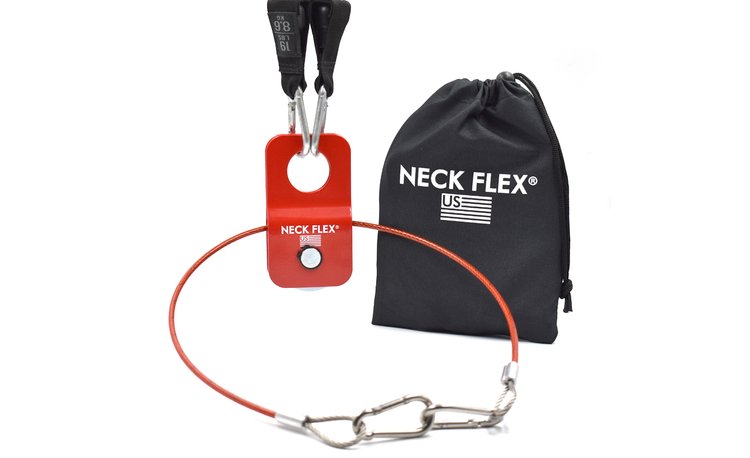
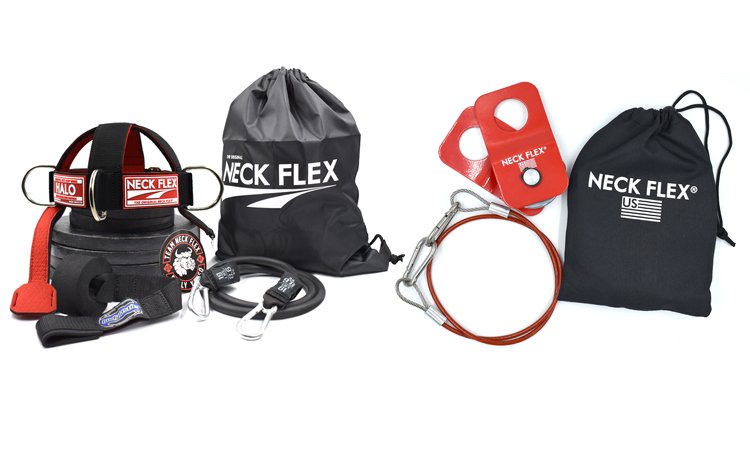
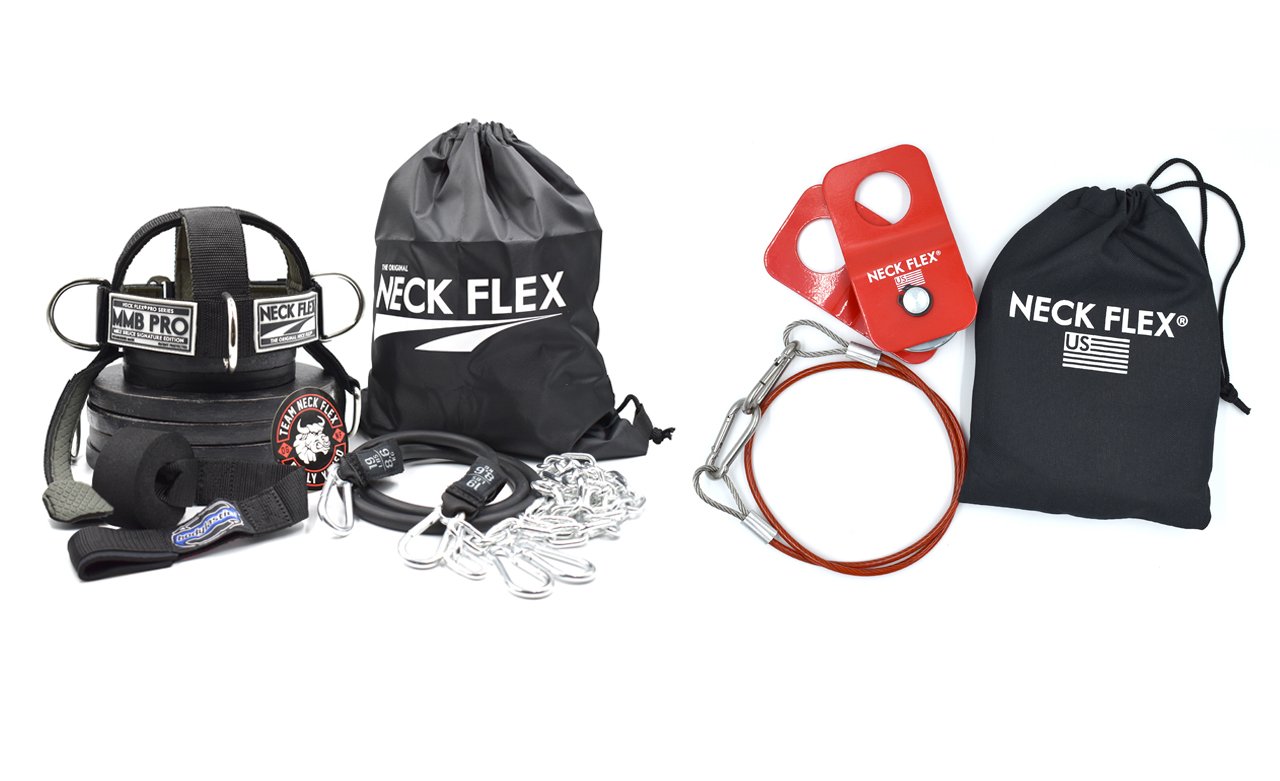
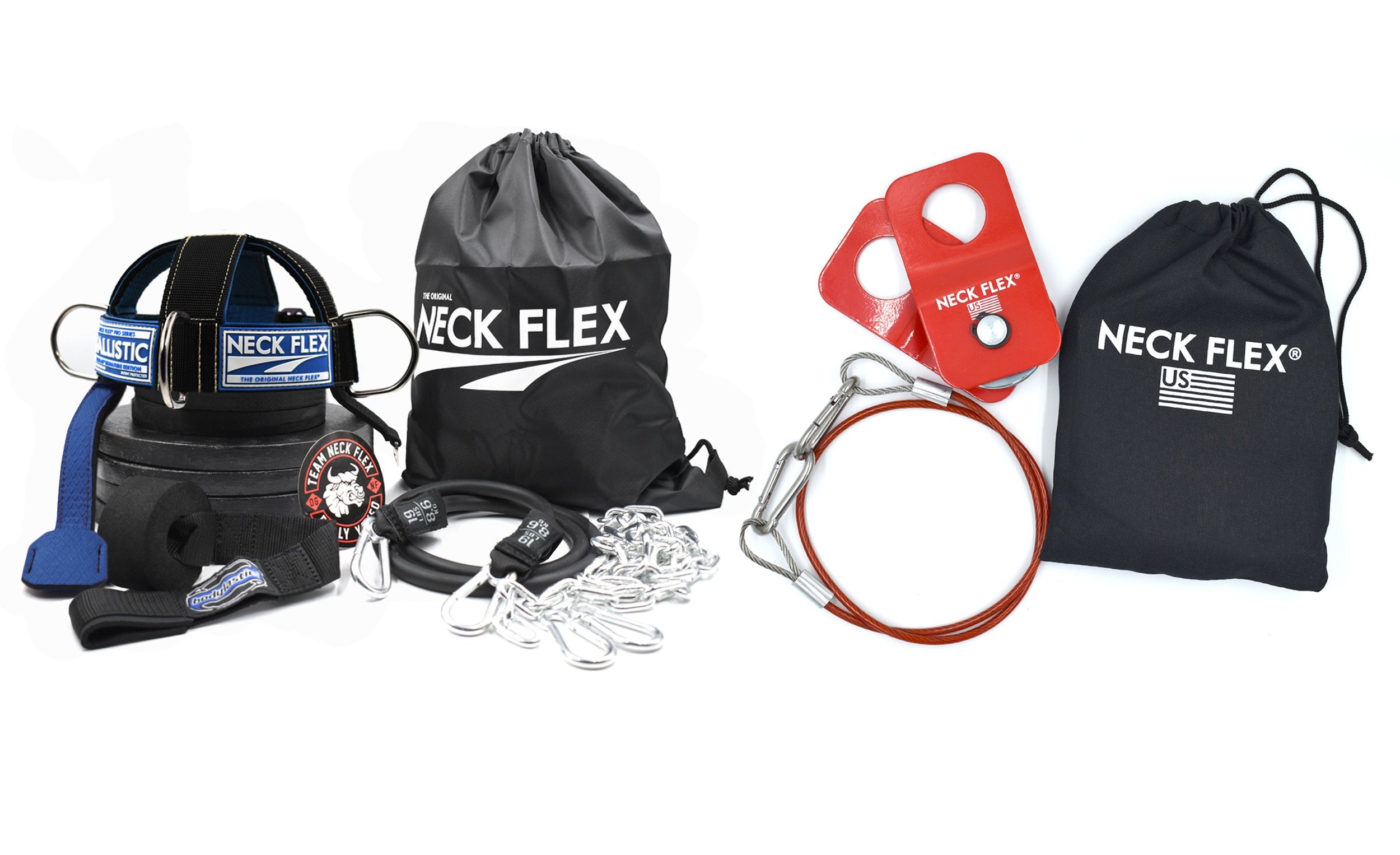
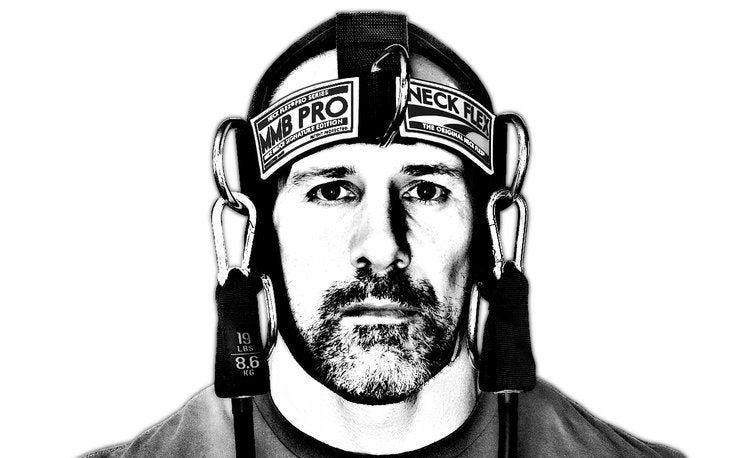
The Neck Flex® is a patented head harness system (five U.S. utility patents, including US 11,007,405), made in the United States. Every kit ships complete and ready to train: the harness, a Bodylastics® resistance band (a USPTO-registered trademark, Reg. No. 3,594,799) built with the patented internal "governor" of U.S. Patent 8,657,727 — a limit cord inside the band that stops it from stretching to its breaking point, so the band can't snap back into your face — a door anchor, a carrying tote, and instructional videos. Three models cover the line. The original HALO Series ($99.95, red) has four vertical D-rings and handles all band work out of the box (a chain or cable stack can attach to its D-rings, though a chain isn't included). The MMB Pro Series ($119.95, black with grey/black PVC patches and heavy-duty stitching) — named for sponsored strongman and neck-training pioneer Mike "The Machine" Bruce — and the Ballistic Series ($134.95, blue/white PVC patches, stitched with Kevlar® thread, famous for a strength-to-weight ratio several times that of steel) add reinforced jaw-line attachment flaps ("dog ears") plus an included chain and two carabiners, for heavy plate-loaded work and cable-stack extensions on top of everything the HALO does. All Neck Flex harnesses are lined with thick diamond-embossed neoprene, which cushions the head and grips against slippage under load — a padding spec the Alpha Harness doesn't share. The patented design uses D-rings positioned around the harness so resistance can be anchored at two points simultaneously — the feature that makes true side (lateral) flexion and controlled rotation possible with even pressure across the head (more on why that matters below).
The Neck Flex is also the neck trainer featured in Apple's 2025 blockbuster "F1: The Movie" starring Brad Pitt, appearing in the training montages for rookie driver Joshua Pearce (Damson Idris). As the Washington Business Journal reported, the placement was unpaid: the film's physical trainer knew the product because Formula 1 drivers — who train their necks against extreme G-forces — actually use it. Brands paid for their product placements in that film; the Neck Flex was there for authenticity.
The Iron Neck (made by Mission Competition Fitness Equipment) is a rigid ring that sits around the head, with a slider on a circular track. Resistance comes from a band anchored to a door or rack; the Pro model adds a friction dial for rotational resistance. The 3.0 ($349) and 3.0 Pro ($599) ship with a 25 lb band, skull cap, and anchors. Iron Neck also sells the Alpha Harness ($59) and Alpha Harness Plus ($89) — strap-style harnesses whose design history is part of this story. Note that the Alpha sold today is not the Alpha as originally released: the current versions are the redesigns that followed two patent lawsuits, detailed below.
What's in the box — and what it really costs
Here's the comparison Iron Neck's pricing makes hard to see at a glance. All prices from both companies' websites, July 2026:
| What you pay | What's included | Ready to train? | |
|---|---|---|---|
| Neck Flex HALO Kit | $99.95 | Harness (4 vertical D-rings), Bodylastics resistance band, door anchor, tote bag, instructional videos | ✅ Yes, out of the box (band work; chain/cable attach to D-rings but chain not included) |
| Neck Flex MMB Pro Kit | $119.95 | Everything above plus jaw-line "dog ear" attachment flaps, chain + 2 carabiners for plate loading | ✅ Yes — band AND heavy plate work |
| Neck Flex HALO Bundle (kit + Revolver) | $139.90 | HALO kit (harness, band, door anchor, tote, videos) plus the Revolver rotation attachment with braided cables and carabiners | ✅ Yes — weighted linear AND rotation, at the line's entry price |
| Neck Flex MMB Pro Bundle (kit + Revolver™) | $159.90 | MMB Pro kit (dog ears, chain + carabiners) plus the Revolver rotation attachment with braided cables and carabiners | ✅ Yes — weighted linear AND rotation |
| Neck Flex Ballistic Bundle (kit + Revolver™) | $174.90 | Everything above in Kevlar®-stitched construction, plus the Revolver rotation attachment with braided cables and carabiners | ✅ Yes — weighted linear AND rotation |
| Iron Neck Alpha Harness | $59 | Harness, nylon tether, 2 carabiners. Per Iron Neck's own page: "Additional accessories, including resistance bands, can be added to your order separately." | ❌ No — requires weight plates you own, or their separate Harness Kit ($39–$55) |
| Iron Neck Alpha + Harness Kit | ~$98–$114 | Harness + one band, door anchor, cinch anchor, bag | ✅ Yes — but no rotation attachment exists for it |
| Iron Neck 3.0 | $349 | Halo device, 25 lb band, skull cap, anchors | ✅ For isometric/linear band work — no rotational resistance (that's the Pro), no weighted flexion/extension |
| Iron Neck 3.0 Pro | $599 | Same, plus rotational tension dial | ✅ For band and rotation work — but see below |
The detail that decides this comparison comes from Iron Neck's own catalog. Their $749 "Strength Bundle" pairs the 3.0 Pro with an Alpha Plus harness, described on their page this way: "Paired with the Iron Neck 3.0 Pro, the Alpha+ Harness adds traditional weighted and band-resisted training."
Sit with that. Iron Neck sells a harness alongside their $599 flagship because the ring, by itself, doesn't do weighted neck training — the neck curls and extensions with real load that build neck size and strength. To get both capabilities from Iron Neck, you're at $749. The Neck Flex HALO Bundle delivers both for $139.90.
Same two capabilities. $574 difference.
Movement by movement: what each system can actually load
Price is half the comparison. The other half is what each device can physically do. Here is the full movement matrix — dynamic means moving through a full range of motion under load, not just holding a static position:
| Movement | Neck Flex + Revolver™ | Iron Neck 3.0 Pro | Iron Neck Alpha Harness |
|---|---|---|---|
| Forward neck flexion (dynamic, weighted) | ✅ Full range | ❌ Isometric holds only | ✅ (with plates/band purchased separately) |
| Rear neck extension (dynamic, weighted) | ✅ Full range | ❌ Isometric holds only | ✅ (with plates/band purchased separately) |
| Side (lateral) flexion (dynamic, weighted) | ✅ Full range, dual-anchor | ❌ Isometric holds only | ⚠️ Single-point anchoring shifts under load |
| Neck rolls | ✅ Full range of motion | ⚠️ Partial — head stays fixed in the ring | ❌ |
| Rotation under resistance | ✅ Revolver™ (neck rolls + rotation), or band clipped to the front D-ring | ✅ Slider-and-track with friction dial (see mechanics below) | ⚠️ Possible in principle via the front D-ring — but the horizontal ring can't fold flush toward the anchor, making the movement awkward (see below) |
Read the rotation row carefully, because it's the one Iron Neck's pricing is built on. Rotational resistance is the 3.0 Pro's signature feature — the reason it costs $599 instead of $349. The Revolver™ adds rotational training to any Neck Flex kit for $49.95, or included in the bundles from $139.90. Here's how the mechanics actually compare.
How rotation training works on both systems
Both systems create rotational resistance the same basic way. A resistance band (or a cable from a weight stack) is anchored at roughly eye level and runs in a straight line to an attachment point at the user's head — think of the line of sight, looking straight ahead. The direction the user faces determines where the pull lands: face the anchor and the band pulls from the front; turn away and it pulls from behind; stand sideways, band over the shoulder, and it pulls from the side. The exercise itself is simple: the user turns their head against the pull — the "nodding no" motion — and the band resists the turn. To work the other direction, they turn their body around and repeat. On the Neck Flex, the band clips to the front D-ring, which pivots flush against the forehead so the pull tracks naturally with the head; the Revolver adds full neck rolls and smoother multi-directional rotation on its twin ball bearings.
The Iron Neck Pro reaches the same exercise by a different route: a single attachment point rides a 360° circular track around the ring. The band stays put while the user turns their head — the ring and head rotate inside the track. The friction dial is a separate feature: it doesn't add band resistance, it makes the slider itself harder to move, resisting the head-turn directly. In our testing — demonstrated in the Neck Flex vs. Iron Neck comparison video — turning the friction up produces a stick-slip effect: the slider catches, holds, then jumps, even for a 6'5", 250-pound athlete. And at maximum friction the slider stops sliding entirely, at which point the whole ring tends to rotate on the user's head instead — the attachment point sits out on the rig, away from the skull, so the leverage works against the fit. The Neck Flex approach to the same "resist the no motion" exercise — band clipped directly to the flush front D-ring — is smoother, and scales to any load a cable stack can supply.
Independent comparison of the Revolver and the Iron Neck Pro by 1st508th Airborne.
And the Alpha? A band clipped to the Alpha's front D-ring can attempt this exercise. In practice, the Alpha's front and back D-rings are oriented horizontally (verified against the current product as of July 2026), so the ring can't fold flush toward the anchor the way a vertical ring pivots; the movement is awkward, and the fit fights the exercise. That is the configuration an independent reviewer called simply "wrong" — and it means the practical rotation path in Iron Neck's catalog runs through the $599 Pro, while any Neck Flex owner has it from the front D-ring alone, or from the Revolver at $49.95.
The current-generation Revolver rotates on twin sealed chrome-steel ball bearings (GCr15 bearing steel — the same alloy class used in industrial bearings) with a zinc-plated axle and powder-coated high-strength steel frame, machined to precision fits. In practice: rotation is silent and stays smooth under real load, because the only resistance you feel is the resistance you loaded — not friction in the hardware.
The design history — a matter of public record
This is the part of the comparison most articles skip, and it's a matter of federal court record.
On December 1, 2021, Judge Alan Albright of the U.S. District Court for the Western District of Texas granted Gonza LLC a preliminary injunction against Mission Competition Fitness Equipment, finding Gonza likely to prove that the Iron Neck Alpha Harness infringed U.S. Patent 11,007,405 — the original Neck Flex patent. The order found all four legal factors favored Gonza and enjoined Mission Competition from "promoting, marketing, advertising, selling, and offering for sale the Iron Neck Alpha Harness" pending trial. The court's own order noted the copying went deep, observing that the Iron Neck Alpha was the same as the Neck Flex "apparently even down to the stitching pattern" (Order Granting Preliminary Injunction, Dkt. 17 at 12, W.D. Tex. Case No. 6:21-cv-00771). The ruling was covered by Bloomberg Law, Law360, and IPWatchdog. Court filings in the case include Gonza's argument that Mission Competition had "simply reverse engineered their patented product and flooded the market with an inferior product."
How unusual is a ruling like this? Here is James Carmichael of Carmichael IP, Gonza's patent counsel:
"It is exceedingly rare that copying a competitor's patented product is so blatant that it results in a preliminary injunction ordering the copyist to stop selling the infringing copy. In fact, outside of the court order against Iron Neck, we are not aware of Judge Albright ever having issued a preliminary injunction against patent infringement based on the merits of the case."
After the injunction, the Alpha Harness changed. The patented vertical power strap disappeared from the design.
In May 2023, Gonza filed a second suit asserting two additional patents (US 11,638,850 and US 11,638,851). During that litigation, the Alpha's D-ring orientation changed as well. The case was resolved in March 2024 by agreement of the parties.
Both companies hold U.S. utility patents — and the distinction between them is the story. The Iron Neck ring device is Mission Competition's own patented design (U.S. Patents 9,555,283 and 10,143,883: a ring-and-track system with a sliding attachment car, invented by Michael Jolly). The strap-style harness is Gonza's invention (the five-patent "Neck Exercise Device and System" family). The litigation happened where those categories crossed: when Iron Neck entered the harness category, a federal court found its Alpha Harness likely infringed Gonza's patent — the same as the Neck Flex "apparently even down to the stitching pattern," in the court's words — and the court's rulings forced the patented features out of the harnesses Iron Neck sells today. Each company invented its own flagship. Only one product category produced an injunction.
The record: a federal judge found our design was likely infringed, the competing harness was redesigned afterward, a second suit followed, and the harness changed again. What we can tell you, as the people who engineered the original, is what those design changes cost the product functionally. That's next.
Why D-ring orientation matters (the part only an engineer of this product would tell you)
The Neck Flex is designed around a simple biomechanical requirement: for side neck flexion and rotation, resistance must anchor at two points — front and back — so tension pulls evenly across the head.
Try lateral flexion (ear toward shoulder) with resistance clipped to a single point on the side of a harness, and physics does what physics does: the harness pulls away from your head at that point, shifts, and rides around. The exercise becomes unstable and uncomfortable, and loading it meaningfully becomes nearly impossible. Anchor front and back simultaneously, and the pull distributes evenly — your neck does the work instead of fighting the equipment. That dual-anchor geometry is central to what the Neck Flex patents protect.

The Neck Flex's D-rings are oriented vertically so the ring pivots and lies flush against the head, and the band pulls in the direction of movement. The current Iron Neck Alpha's front and back D-rings are oriented horizontally (verified against the current product, July 2026) — the ring cannot fold flush toward the anchor, so the pull sits away from the head and the movement feels wrong. Independent review agrees on the consequence: Strength Classroom's hands-on comparison states plainly that the Alpha's front and back D-rings "should be vertical" and that the harness is very hard to use as configured. Combined with the removal of the power strap, the harness that emerged from two lawsuits is meaningfully different from — and, in our engineering judgment, functionally reduced from — the design the court found likely infringed ours.
Reviewers and forum users regularly note that budget harnesses shift and pull away from the head under lateral load. The dual-anchor design exists to solve exactly that.
The four-movement test
There's a simple way to evaluate any neck trainer: can it perform the four basic movements used in sport, rehabilitation, and neck-pain programming — rear neck extension, forward flexion, side (lateral) flexion, and neck rolls — under real, progressive load?
We demonstrated this on video, and the results match what Iron Neck's own catalog implies. The ring-and-track design applies horizontal band tension to a fixed head ring — well suited to isometric holds and rotation, but not to dynamic, gravity- or plate-loaded flexion and extension through a full range of motion. Iron Neck's own Strength Bundle adds a strap harness "for traditional weighted and band-resisted training." Independent reviewers reach the same conclusion: in his hands-on test of every major neck trainer, Strength Classroom's reviewer describes the Iron Neck 3.0 as mainly a static exercise, noting you can't perform flexion, extension, or lateral flexion with it (an affiliated reviewer who discloses discount codes). The Neck Flex kits perform all four movements loaded — with the band, the chain and plates, or both — and add rotation via the Revolver.
Our side-by-side demonstration of the four movements on both systems.
Strength Classroom's independent full test of the major neck trainers (an affiliated reviewer who discloses discount codes).
For football programs and combat athletes, this is the practical bottom line: the four basic movements are the foundation of every serious neck program, and a device should be able to load them.
Where the Iron Neck fits
The Iron Neck 3.0 Pro is a well-made device for what it does. The rigid ring and slider give smooth, consistent isometric resistance through rotation, the AirFit bladder fits it snugly to different head shapes, and it's earned a real following in physical therapy and prehab settings where controlled, low-load, friction-smooth movement is the goal. If your use case is clinical rehab programming with budget to spare — or you simply want that specific ring-and-track training feel — it's a legitimate choice, and their 60-day guarantee is fair.
What it is not, by Iron Neck's own catalog structure, is a complete strength-training system on its own. And at $349–$599 before adding the harness that completes it, it should be.
Who should buy which
Choose the Neck Flex (with the Revolver) if: you want one complete system for building a bigger, thicker, stronger neck — weighted flexion and extension, lateral work with even dual-anchor loading, and rotation — for under $175, from the company that holds the five patents on the design. This covers combat sports, football, bodybuilding and neck hypertrophy, and band-based rehab.
Choose the Iron Neck 3.0 Pro if: your priority is smooth ring-based isometric and rotational work, particularly in a clinical or prehab context, and the price difference doesn't matter to you. Budget the full ~$749 bundle if you also want weighted training.
Skip the bare Alpha Harness either way: at $59 plus the accessories needed to actually train, you land at Neck Flex kit pricing anyway — for a harness whose defining design features were removed or reoriented across two patent lawsuits.
If you want to check the evidence yourself
One thing this comparison has deliberately not leaned on, because it deserves its own page: the Neck Flex harness is named by brand and manufacturer in the methods sections of three peer-reviewed papers from a Royal Danish Air Force trial — the 2015 protocol and 2017 primary-outcome paper in BMC Musculoskeletal Disorders, and a 2020 secondary analysis in Frontiers in Public Health. The Neck Flex® is the consumer neck harness named in the literature this way.
What that means: a research team chose this harness as trial equipment and put it on 69 aircrew, unsupervised, three times a week for twenty weeks.
The full account, with the papers linked, is here: Peer-reviewed research on neck training harnesses. If you are weighing this against the cheaper end of the market rather than against the Iron Neck, see Best Iron Neck alternatives (2026).
FAQ
Is Neck Flex or Iron Neck better for getting a bigger neck?
Neck size comes from progressive weighted flexion, extension, and lateral work. The Neck Flex kits support all of it out of the box (band and plate loading). The Iron Neck ring does not support weighted neck curls — Iron Neck pairs it with a separate harness for that.
Does the Neck Flex do rotation like the Iron Neck?
Yes. Rotational training on a Neck Flex works two ways: clip the resistance band (or a cable-stack cable) to the front D-ring, which pivots flush at the forehead, and turn the head against the pull — the "nodding no" motion — or add the Revolver™ Rotation Attachment ($49.95, or included in bundles from $139.90) for full neck rolls and multi-directional rotation on twin chrome-steel ball bearings, silent and smooth under load. The Iron Neck Pro performs rotation via a slider on a circular track with a friction dial; the Neck Flex approach uses band or cable resistance instead of friction, so it scales to any load without the stick-slip behavior friction can produce.
Did Iron Neck copy the Neck Flex?
In December 2021, a federal judge granted Gonza LLC a rare preliminary injunction, finding it likely that the Iron Neck Alpha Harness infringed the original Neck Flex patent, U.S. Patent 11,007,405. The court's order observed that the Alpha was the same as the Neck Flex "apparently even down to the stitching pattern." The ruling was covered by Bloomberg Law, Law360, and IPWatchdog. A second patent suit filed in 2023 was resolved by agreement in March 2024. The bottom line for buyers: the court's rulings forced Iron Neck to remove the Neck Flex's patented features from the Alpha harnesses it sells today.
Neck Flex harness vs. Iron Neck Alpha Harness — which is the better harness around $100?
This is the real head-to-head for most shoppers. The Alpha ($59–$89) includes only the harness, a tether, and two carabiners — add the accessories needed to actually train (their Harness Kit, $39–$55) and you're at $98–$144. In the same bracket, the Neck Flex HALO ($99.95) or MMB Pro ($119.95) arrives complete: harness, snap-resistant Bodylastics® band, door anchor, tote, and instructional videos (MMB Pro adds the chain, carabiners, and dog-ear flaps). The design differences favor the Neck Flex where it counts: vertical D-rings that pivot so resistance pulls in the direction of movement (the Alpha's front and back D-rings are horizontal — a configuration an independent reviewer called simply "wrong"), dual-anchor lateral flexion that keeps the harness seated evenly, and thick diamond-embossed neoprene lining against slippage. And the Neck Flex is the patented original — the design a federal court found the Alpha likely infringed in 2021.
What comes with a Neck Flex kit?
Every kit includes the harness, a Bodylastics resistance band, a door anchor, a carrying tote, and instructional videos. The MMB Pro and Ballistic Kevlar® kits also include a chain and two carabiners, plus jaw-line "dog ear" attachment flaps for heavy plate loading. Kits run $99.95 (HALO) to $134.95 (Ballistic Kevlar®); bundles with the Revolver run $139.90–$174.90.
Which do UFC fighters and football players use?
Both brands appear in professional training settings. Neck Flex equipment is documented in public footage training professional and UFC-level fighters, and has been purchased by the United States Air Force, Australian Air Force, Belgian Air Force, and the Canadian Special Forces. Formula 1 drivers also use the Neck Flex — which is how it ended up on screen in "F1: The Movie."
Is the Neck Flex the neck harness in the F1 movie?
Yes. The Neck Flex appears in the training montages for rookie driver Joshua Pearce (Damson Idris) in Apple's 2025 film "F1: The Movie" starring Brad Pitt. The Washington Business Journal reported the placement was unpaid — the film's physical trainer was familiar with the product because F1 drivers use it to train their necks against racing G-forces — and that Neck Flex sales rose roughly 50% over typical summer levels after the film's June 2025 release.
Prices and product contents verified against both companies' websites, July 2026. Patent and litigation facts per public court records (W.D. Tex. Case Nos. 6:21-cv-00771 and 6:23-cv-00395), Bloomberg Law, and IPWatchdog. Neck Flex® and Revolver™ are trademarks of Gonza LLC, Leesburg, Virginia.
A longer account of the trial behind this comparison — and of every device category, including the ring-and-track class — is at necktraining.com/neck-flex.

