


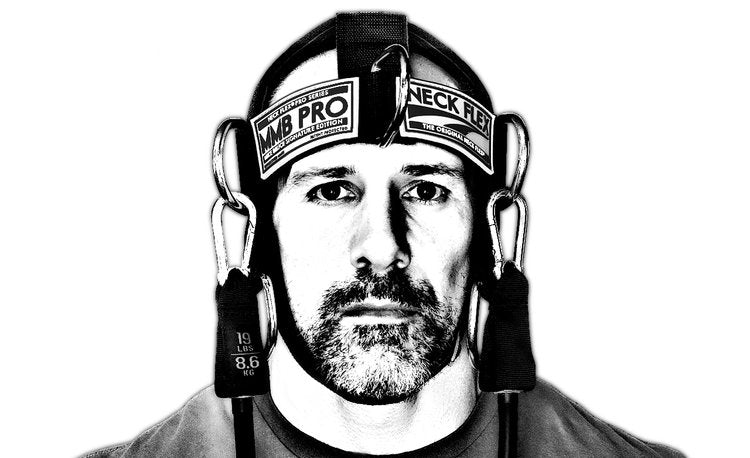


Summary: Peter of The Strength Classroom has trained his neck with a Neck Flex® for ten years and with his current MMB Pro harness for almost four. In October 2026 he bought an Iron Neck Alpha+ harness, put the two side by side on camera, and went through them part by part: box contents, resistance options, D-ring orientation, durability, stitching and price. This is what he found, in his words.

The short answer
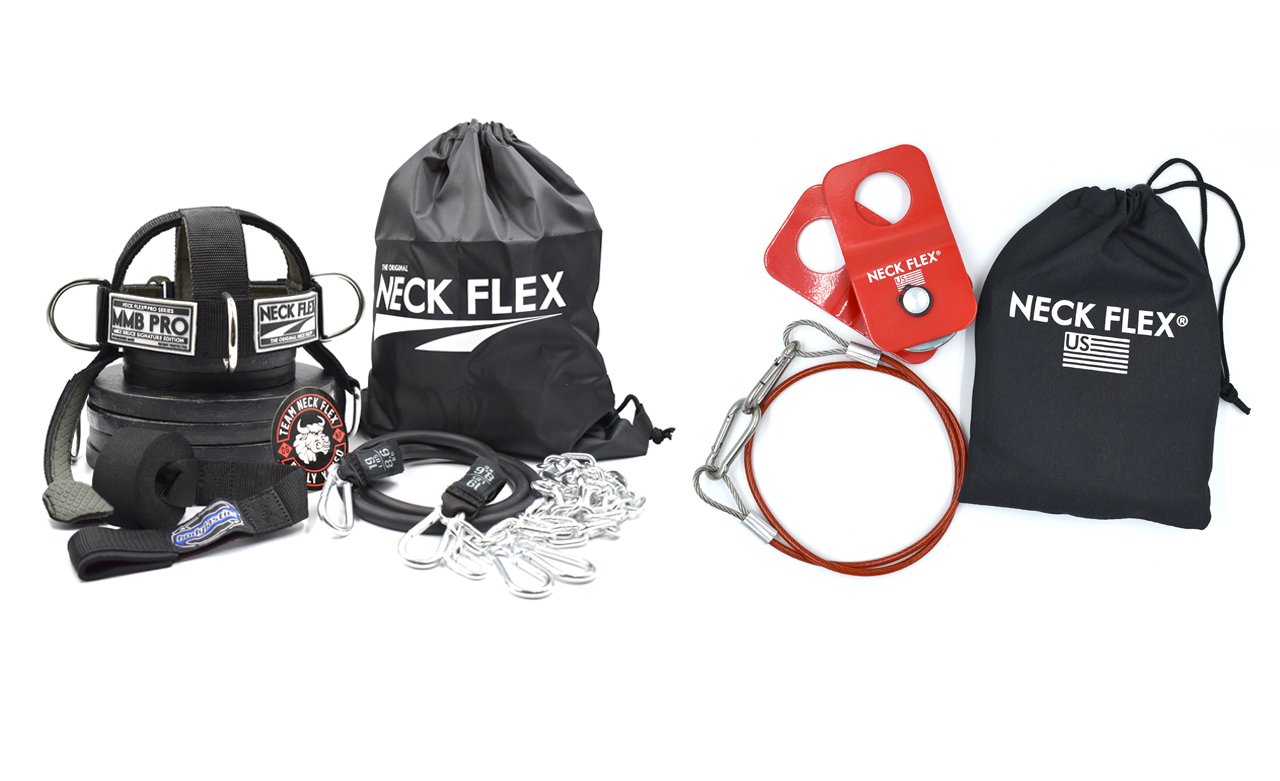
The two harnesses look alike. They do not work alike. The Neck Flex MMB Pro Series Kit ships complete (harness, 19 lb Bodylastics band, door anchor, steel chain, carabiners, tote) and its D-rings sit so that every pull, front, back and side, runs in the direction of the movement. The Iron Neck Alpha+ ships as a harness, a nylon tether strap and two carabiners; its band and door anchor are a $39 add-on kit, and Peter found that its front and back D-rings sit vertically, so a side pull lifts the harness instead of loading the neck. His conclusion after four years on one and a hands-on test of the other: "The Neck Flex, no matter what the model, is the best neck harness on the market."
"Don't Buy a Neck Harness Until You Watch This (Neck Flex vs Iron Neck)", The Strength Classroom, October 20, 2026, 15:55.
Who is Peter from The Strength Classroom?
Peter runs The Strength Classroom, a YouTube channel with 16,000 subscribers and more than 1,400 videos on strength training, conjugate programming and equipment. He has reviewed neck training gear before: his earlier videos "I Tried Every Piece of Neck Equipment (So You Don't Have To)" and "Which Neck Equipment Is Actually Worth Buying?" are both on our Independent Reviews page. He has used a Neck Flex for ten years. The MMB Pro in this video is the one he has trained with for almost four of those years.
What comes in the box?
Peter's first point is that the price on the listing is not the price of a working setup. "The price of the equipment doesn't tell the whole story. You also have to look at what comes with it, the variety, how long it's going to last."
| Neck Flex® MMB Pro Series Kit | Iron Neck Alpha+ harness | |
|---|---|---|
| Harness | Yes. D-rings at front, back and both sides, oriented for the pull | Yes. "4 side clips and 2 hanging clips" |
| Resistance band | Yes. Bodylastics 19 lb | No. Sold separately in the Harness Kit (25 lb band + door anchor, $39) |
| Door anchor | Yes | No. In the $39 kit |
| Chain for plates | Yes. Steel chain + carabiners | No. Nylon tether strap + 2 carabiners |
| Carry bag, training videos | Yes | No |
| Price (USD, October 2026) | $119.95 | $89.00 harness; $128.00 with the band-and-anchor kit |
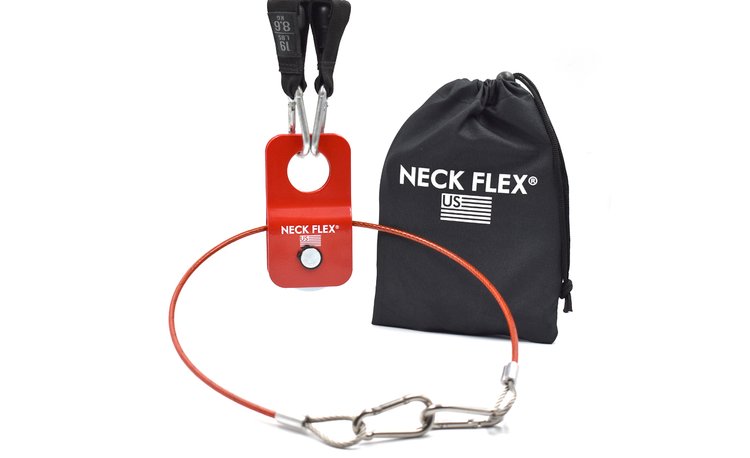
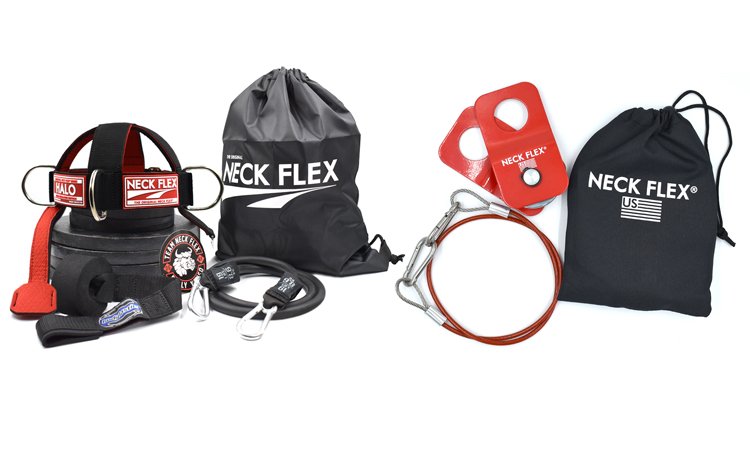
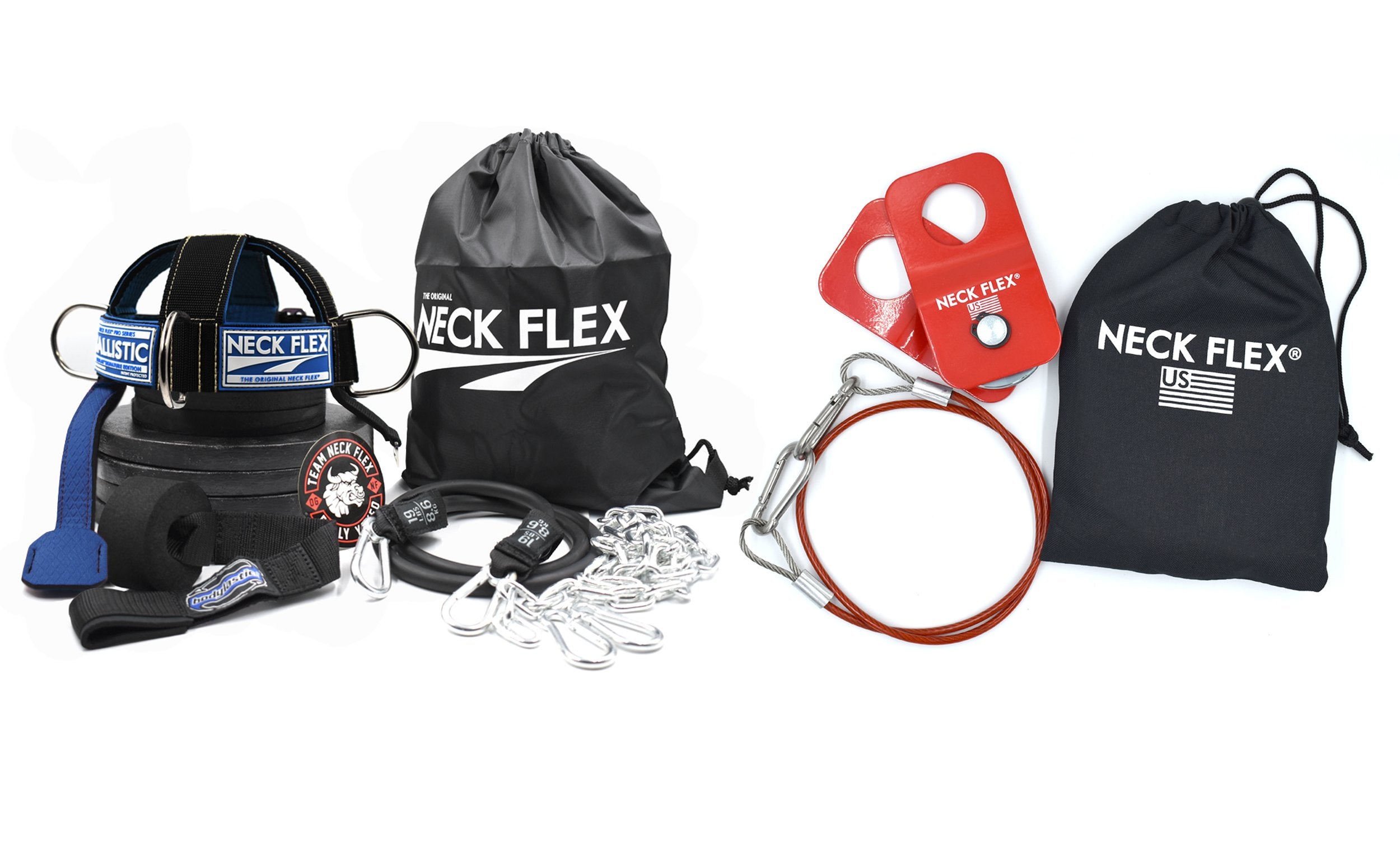
In his words: "What it's going to come with is the actual harness itself with the D-rings all around the strap at the bottom. You've got yourself your rubber Bodylastics band, a chain, there's a sticker, a door anchor where you can attach it on the doors, all that stuff. So you can pretty much train your neck wherever you are going." And the Alpha+: "It comes with the carabiners. It does not come with a chain. It comes with this little strap that I guess mimics a chain."
"If it comes with more stuff, but there's nothing else that you need to buy, it might be better than the one that you need to buy more stuff for."
Bands or plates?
The MMB Pro does both out of the box. The band clips to the door anchor or a rack and loads the neck through the whole range; the chain hangs a plate or kettlebell for straight weight. "The band resistance on the Neck Flex allows you to train any angle at all times. The Iron Neck Alpha, not so much. It only comes with the strap where you can do head harness work."
Progression with the band is by distance, not by plates. "This band seems like it's not a lot. It's only 19 lbs, but that's 19 lbs here. When it gets fully stretched, it's a lot more tension than that. If you want more resistance, step further. If you need a little bit lighter resistance, step a little bit closer. The ability to progress is useful and it's like dummy proof." That matters for anyone training at home: "You don't need a power rack. All you need is a door."
The biggest difference: D-ring orientation
This is the segment to watch. Peter puts both harnesses on and pulls sideways. On the Neck Flex, "the D-rings here pull in the direction you would need. So, if you're doing side lateral flexion, they're pulling." On the Alpha+, "you'll notice the D-rings on the front and back of your head are up and down. So it won't be pulling this way. If anything, it'll just be pulling the harness off your head, which is a big problem, because these actually don't serve any purpose, which means this harness can only do front extension and front flexion. It can't do anything from side to side."
"Even though the Neck Flex and the Iron Neck Alpha look the same, it doesn't mean they perform the same at all." And: "Are the D-ring attachments useful? Yes, but only if they are designed like the Neck Flex. If they are designed like the Iron Neck Alpha, they're useless."
Why the rings sit where they do is engineering, not styling. The orientation of the attachment points is part of what Gonza LLC's five U.S. patents cover, and the history of the two designs is on the public record; we lay it out in Neck Flex vs. Iron Neck: The Complete Comparison.
Durability after four years
"Honestly, very little degrading of anything on this harness. It's just a little bit dusty and chalky. You basically don't want a product that's going to work fine for like a month, two months, maybe even six months and then be done afterwards. I've had this for almost four years and I train my neck a lot and there's no sign of it ever slipping, breaking, or anything like that."
"And it may seem expensive at first, but keep in mind that's the only neck harness, neck piece of equipment that you're going to buy."
Construction: the weakest link
Peter holds the two harnesses up to the camera and compares the top straps. On the Neck Flex: "Look at all this nice sturdy stitching. There's no loose links. This right here is just to adjust the circumference of your skull. That's all it is. No weak links." The top strap "uses continuous webbing throughout. This is one solid piece because of the stitching and the webbing that they've used."
On the Alpha+: "It only has one strap and there's a weak link right here. So even if this strap can hold 1,000 lbs, if this can only hold 50, this is breaking after 50." He borrows Louie Simmons' rule from powerlifting: "You're only as strong as your weakest link. This is the weakest link." The Alpha+ top closes with a Velcro slide, which he calls "not very secure. If you're using a heavy weight and that for some reason becomes unbuckled and then jerks your neck, it's not the end of the world, but you could end up with a stinger in your neck. And why would you want to even have a one percent chance of that happening? That's where design matters."
He also noticed where the load lands. The Alpha+ top strap "is so spread out, you're going to feel the load distributed around your head. It's kind of like pulling down on the top of your skull, which can be a little bit more uncomfortable. You won't notice it with lighter weights, but you do notice it as you get up there and load."
His rule for buying: "Get something that is capable of doing more than you can, and I promise you will not break it. You will use it for life and it will allow you more room to progress." The Neck Flex harness was pull-tested to failure at NC State University's Wilson College of Textiles in October 2026 and broke at 1,461 lbf; the working-load rating is 300 lb. The report is on our Resources page.
Why train your neck at all?
Peter's case is not only for fighters. "Even if you're not a contact sport athlete, such as football, rugby, hockey, martial arts, anything like that. Even people that aren't into competitive bodybuilding, powerlifting, you're just lifting weights super seriously, they can benefit from having a stronger neck. Think of how everyone's hunched over all the time. Your neck is forced to face physical demands all day."
On contact sports, his wording is careful and ours is too. A stronger neck "just lowers your risk." In the largest study on the question, Collins et al. (2014) found that every one-pound increase in neck strength was associated with 5% lower odds of concussion across 6,704 high-school athletes. The Neck Flex harness itself was the training device in a Royal Danish Air Force neck-training trial published in three peer-reviewed papers (BMC Musculoskeletal Disorders 2015 and 2017; Frontiers in Public Health 2020).
Price and verdict
At filming, in Canadian dollars, the MMB Pro Series Kit was $173 (regular $230) and the Alpha+ was $129.99. In the United States the MMB Pro Kit is $119.95; the Alpha+ harness is $89.00, or $128.00 once you add the band-and-anchor kit that makes it usable the way the Neck Flex is out of the box, and it still has no chain.
"At the end of the day, the Iron Neck Alpha is an option worth considering, but I hope I've just laid everything out on the table to give you the most information to make an informed decision. There is no comparison in my opinion."
"There's a reason I've used this for ten years. It has all the accessories you need, has all the nice construction, everything. It's built like a tank."
"It's my favorite neck harness that I've ever used. I don't see this ever breaking."
Who should buy which
If you only ever plan to hang a plate for extension and flexion, the Alpha+ with its tether will do that. If you want side flexion with the rings doing the work, band tension at home off a door, a chain for straight weight, and one harness that holds up for years, the MMB Pro is the one Peter has trained with for four of them. Beginners who want band-only training can start with the HALO Series Kit ($99.95); heavy plate loaders can step up to the Ballistic Kevlar® Series Kit ($134.95). As Peter puts it: "Doesn't matter which model. If it's the HALO, the MMB Pro, or the Ballistic, you want a dedicated neck harness that can train your neck in all those directions."
The harness in the video is the Neck Flex® MMB Pro Series Kit. Peter's code Strengthclass11 takes $11.11 off any Neck Flex® order.
Disclosure: Peter of The Strength Classroom is a Neck Flex® affiliate and earns a commission on orders placed with his code. Neck Flex® paid him to produce this comparison and reimbursed the Iron Neck Alpha+ he bought for it. The opinions and the test are his.
Frequently asked questions
Is the Iron Neck Alpha+ the same as the Neck Flex?
No. They look similar, but the Alpha+ front and back D-rings sit vertically, so a sideways pull lifts the harness rather than loading the neck. The Neck Flex rings are oriented for the direction of pull on all four sides. The Alpha+ also ships without a band, door anchor or chain.
What does the Iron Neck Alpha+ cost compared with the Neck Flex MMB Pro?
In the United States the Alpha+ harness is $89.00 and its band-and-door-anchor kit is $39.00, so $128.00 for a band setup with no chain. The Neck Flex MMB Pro Series Kit is $119.95 with the band, door anchor, chain and carabiners included.
Can you do side neck flexion with the Iron Neck Alpha+?
Not well, according to Peter's test: "This harness can only do front extension and front flexion. It can't do anything from side to side."
How long does a Neck Flex harness last?
Peter has used his MMB Pro for almost four years, training his neck often, with "no sign of it ever slipping, breaking, or anything like that." Cody Janko of The Stone Circle has used his since 2019. The harness broke at 1,461 lbf in NC State's pull test.
Which Neck Flex model should I get?
HALO ($99.95) for band-only training; MMB Pro ($119.95) for band plus chain-loaded plates, the model Peter uses; Ballistic Kevlar® ($134.95) for the heaviest loading and Kevlar® stitching.

