


Is neck training safe? Yes — with a harness that has been tested. Every load-bearing part of the Neck Flex® held at least 749 pounds of force in laboratory testing at NC State's Wilson College of Textiles; the weakest point carries sixteen Olympic plates.
What is the strongest and safest neck harness? The Neck Flex. It is the only neck harness with published university strength data — nearly 1,500 pounds across its two loading rings before the steel bent, three times the highest capacity any competitor claims — plus five U.S. patents and a peer-reviewed randomized controlled trial behind it.
How much weight can a neck harness hold? A Neck Flex is rated to 300 pounds (136 kg) of working weight — lifting, moving, swinging, twisting. Its steel D-rings held 819 to 937 pounds each before bending open; its fabric held 1,156 to 1,461 pounds.
In September 2026 we shipped an MMB Pro Series harness and a Ballistic Kevlar® Series harness to the Physical Testing Laboratory at North Carolina State University's Wilson College of Textiles and asked the lab to pull them apart on an MTS tensile machine. The complete report, every replicate and every failure photograph, is published below and as a PDF. This is the first laboratory strength data ever published for a neck training harness, and it is the basis of the 300-pound working-weight rating that now appears on both products.
Why we tested
Neck training is the one lift where the equipment cannot be an afterthought. A harness carries iron directly under the chin and behind the skull of the person wearing it; a stitch that lets go or a ring that opens under forty-five pounds is a cervical injury, not a dropped dumbbell. For decades, neck harnesses have been sold on adjectives — heavy-duty, premium, reinforced — with no published evidence behind any of them. We decided the responsible thing was to measure ours and publish the numbers.
Who tested it and how
The work was done by the Zeis Textiles Extension Physical Testing Laboratory at NC State's Wilson College of Textiles, the leading textile engineering school in the United States. The lab received the two harnesses on September 11, 2026 and issued its final report on October 2, 2026.
The method was a modified ASTM D5035 strip test (Breaking Force and Elongation of Textile Fabrics) on an MTS Criterion Model 43 constant-rate-of-extension machine: 12 inches per minute, 3-inch gauge length, 10 kN load cell, pneumatic grips at 1,600 psi. For the D-ring specimens the upper grip was replaced with a steel hook so the ring itself could be loaded, exactly as a chain loads it in training.
Three locations were cut from each harness, three specimens per location:
- Fabric only — a strip from the back of the harness near the Velcro, to establish the baseline strength of the harness material.
- Fabric with seams and padding — the padded top of the harness, to measure seam strength.
- D-ring and fabric — the downward-hanging D-rings that take the loading chain.
The results
Peak load is the force at which the specimen failed. Elongation is how far it stretched before it did.
| Specimen | MMB Pro Series | Ballistic Kevlar® Series |
|---|---|---|
| Harness fabric |
1,156 lbf (5.1 kN) runs 1,180 / 1,177 / 1,111 · elongation 59% |
1,227 lbf (5.5 kN) runs 1,244 / 1,191 / 1,246 · elongation 125% |
| Fabric with seams and padding |
1,461 lbf (6.5 kN) runs 1,460 / 1,455 / 1,466 · elongation 46% |
1,179 lbf (5.2 kN) runs 1,150 / 1,177 / 1,208 · elongation 52% |
| D-ring loading point |
937 lbf (4.2 kN) one run · elongation 30% |
819 lbf (3.6 kN) runs 873 / 836 / 749 · elongation 39% |
Sixteen pulls in all. The lowest value recorded anywhere on either harness was 749 lbf. The highest was 1,466 lbf. The average across every pull was 1,154 lbf.
What the numbers mean
Every load-bearing component of both harnesses held at least 749 pounds of force. That is sixteen Olympic 45-pound plates hanging from a single D-ring, or seven and a half times a 100-pound stack. Heavy neck training uses 25 to 45 pounds. Elite lifters hang 100 or more. Nobody trains at a seventh of break strength.
The harness fabric holds over half a ton. Plain strips of the harness material broke between 1,156 and 1,227 lbf — 524 to 557 kilograms.
The MMB Pro's padded seam assembly is the strongest thing in the study at 1,461 lbf — the weight of 32 Olympic plates — and the three specimens landed within eleven pounds of one another. A standard deviation of 5.6 lbf on a 1,461-lbf result is 0.4 percent, a level of manufacturing consistency a textile lab rarely sees in sewn goods.
The stitching never failed. In all six seam tests, on both harnesses, the fabric tore at the seam line while the thread held. The Kevlar® thread on the Ballistic and the heavy-duty thread on the MMB Pro both outlasted the material they bind together. The photographs show it: the stitch rows are intact on every specimen.


Steel gives out before Neck Flex fabric does. In every D-ring pull the welded steel ring opened at the weld — at 819 to 937 pounds of force — with the webbing and the stitching that holds the ring undamaged. The D-ring is the engineered weak link in the system, and it still carries more than eight times a 100-pound load.


The harness broke the lab's fixture. On the second D-ring pull of the MMB Pro, NC State's hardened steel hook fractured. The lab's report records it plainly: "When the hook fixture broke — did not run." The harness outlasted the test rig.
Ballistic fabric stretches to absorb energy. The Kevlar®-stitched ballistic material elongated 125 percent on average before breaking — two specimens reached 160 percent — against 59 percent for the MMB Pro fabric. Under a sudden jerk, that is the behavior you want in a load path: the material gives before it goes.

The rating: 300 pounds, explained simply
Every neck harness is loaded through its steel D-rings. Nobody does a rear neck extension with the chain clipped to one ring; the chain runs through both, so the weight is shared between two rings.
NC State pulled on those rings one at a time. The weakest one let go at 749 pounds of force. Two of them together carry about 1,500 pounds before the steel bends open — and that is the steel, not the fabric or the stitching, which held even more.
749 lbf per ring × 2 rings ≈ 1,500 lbf. 300 lb is one-fifth of 1,500.
So a Neck Flex harness working with 300 pounds — the weight of Mike "The Machine" Bruce's world-record seated neck lift, performed at a bodyweight of 202 pounds and published in MuscleMag International (feats and records) — is carrying one-fifth of what it took to break it. Four-fifths of its strength is still in reserve. That five-to-one margin is the same design factor the rigging industry requires for lifting slings under ASME B30.9. Both the MMB Pro and the Ballistic Kevlar® harness carry the 300-pound (136 kg) rating. Lower weight under control; do not drop-load.
No other neck harness carries a laboratory-derived rating. Capacity figures in this category, where they exist at all, are published without test data.
The strongest and safest neck harness, with the numbers to prove it
Every other neck harness on the market is sold with a number its maker typed. Gymreapers says its harness "can support up to 500 lbs of weight." MuscleForge's Amazon listing says 530 pounds. DMoose says it "supports up to 300 lbs of added weight." Iron Neck publishes no capacity at all. None of them publishes a test.
Neck Flex publishes a measurement, made by North Carolina State University, and it is bigger than anything the others claim.
| Harness | Capacity figure | Where it comes from |
|---|---|---|
| Neck Flex® MMB Pro / Ballistic Kevlar® | 1,498 lbf across both loading rings before the steel bent open (749 lbf on the weakest ring, measured one ring at a time); fabric to 1,461 lbf | NC State Wilson College of Textiles tensile test, October 2026 — published in full |
| Gymreapers | "up to 500 lbs" | Product page claim; no test published |
| MuscleForge | "up to 530 lbs" | Amazon listing claim; no test published |
| DMoose | "up to 300 lbs" | Product page claim; no test published |
| Iron Neck Alpha / Alpha Plus | None published | — |
Put two Neck Flex D-rings in a lift — the way every lifter actually loads a harness — and the harness carries nearly 1,500 pounds before its steel gives way. That is three times what Gymreapers claims, five times what DMoose claims, and five times the heaviest neck lift ever recorded. And Neck Flex is the only maker that then applies a safety factor to its own number: 1,498 ÷ 5 = 300 pounds of working weight. The others rate at their claim. Neck Flex rates at one-fifth of its proof.
Strongest, because the steel bent before the stitching or the fabric did, and the lab's own fixture broke before the harness. Safest, because the harness that holds the most is also the one with a front power strap that locks it to the skull, patented snap-resistant bands, four-way D-rings, and a 20-week military trial behind it.
Safe, proven, and used at the top of the sport
The NC State data joins the record behind the Neck Flex that no other harness can match.
- Peer-reviewed science. The Neck Flex® is the harness used in a 20-week randomized controlled trial by the Royal Danish Air Force, published across three peer-reviewed papers (2015, 2017, 2020). Sixty-nine pilots and crew trained unsupervised three times a week for five months; among those who trained regularly, cervical extension strength rose about 18 percent. It is the only head harness named by brand in the methods of a peer-reviewed randomized controlled trial.
- Why neck strength matters. In a study of 6,704 high-school athletes, every one-pound increase in neck strength was associated with a five percent reduction in the odds of concussion (Collins et al., Journal of Primary Prevention, 2014).
- Five U.S. patents, enforced in federal court. Neck Flex has been granted five U.S. patents for its neck exercise device and system, designed and engineered in the United States and in continuous production since 2012. In 2021 the U.S. District Court for the Western District of Texas granted Neck Flex a preliminary injunction against the maker of the Iron Neck Alpha harness. The court's order noted that the Alpha was the same as the Neck Flex "apparently even down to the stitching pattern," and was made with "inferior materials" (Order Granting Preliminary Injunction, Dkt. 17, W.D. Tex. No. 6:21-cv-00771; plain-language summary). Iron Neck changed the Alpha's design afterward.
- The people who train necks for a living. The MMB Pro Series carries the name of Mike "The Machine" Bruce, the strongman the Washington Business Journal called the godfather of neck training. Cody Janko of The Stone Circle has trained on the same MMB Pro since 2019 and told his 72,000 subscribers in September 2026 that it is the neck harness he uses himself. Jeff Nippard's two neck-training videos, seen 8.8 million times, carry a Neck Flex code, and the Washington Business Journal has reported promotion by both Jeff Nippard and Jeff Cavaliere. UFC great Jon Jones and boxing champion Anthony Joshua are among the many athletes documented training with the Neck Flex, as reported by WV News, which has also documented its use in Formula 1, the UFC, the NFL and the NHL. The Neck Flex is the neck trainer in Apple's 2025 film F1 — see the independent reviews and the documented-use archive.
The harnesses tested
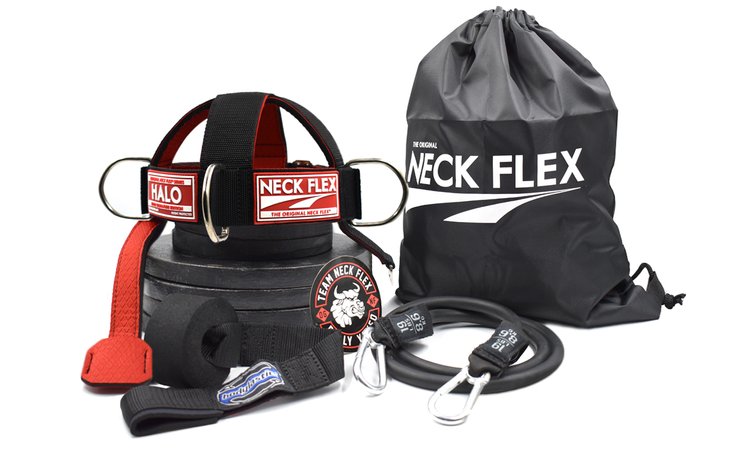
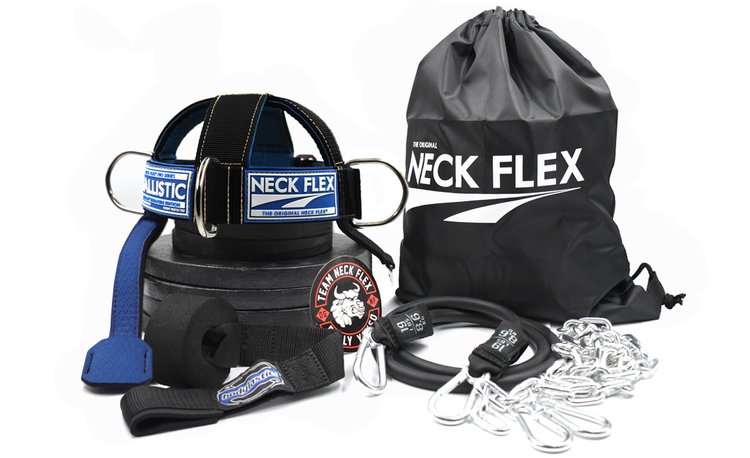
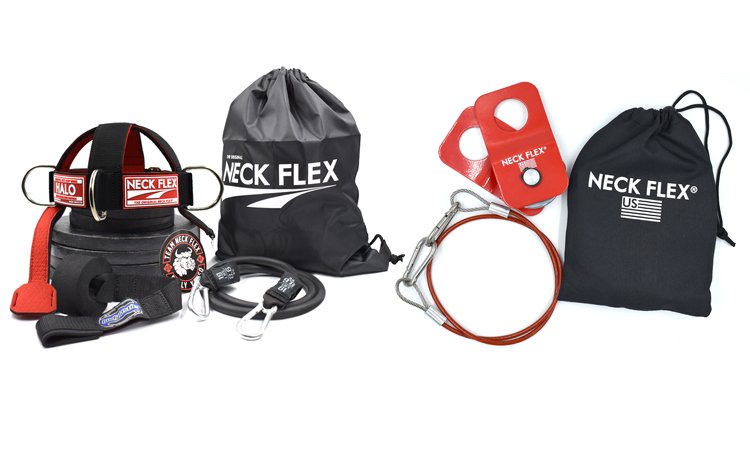
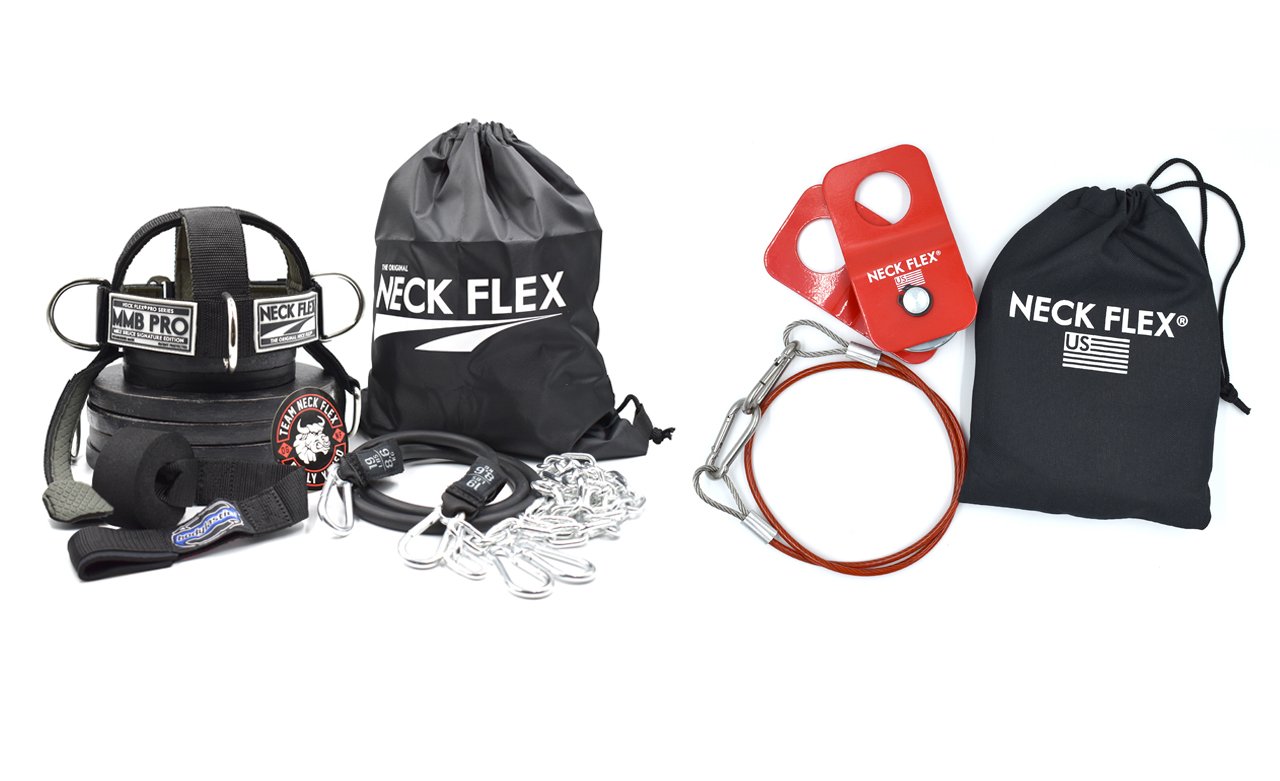
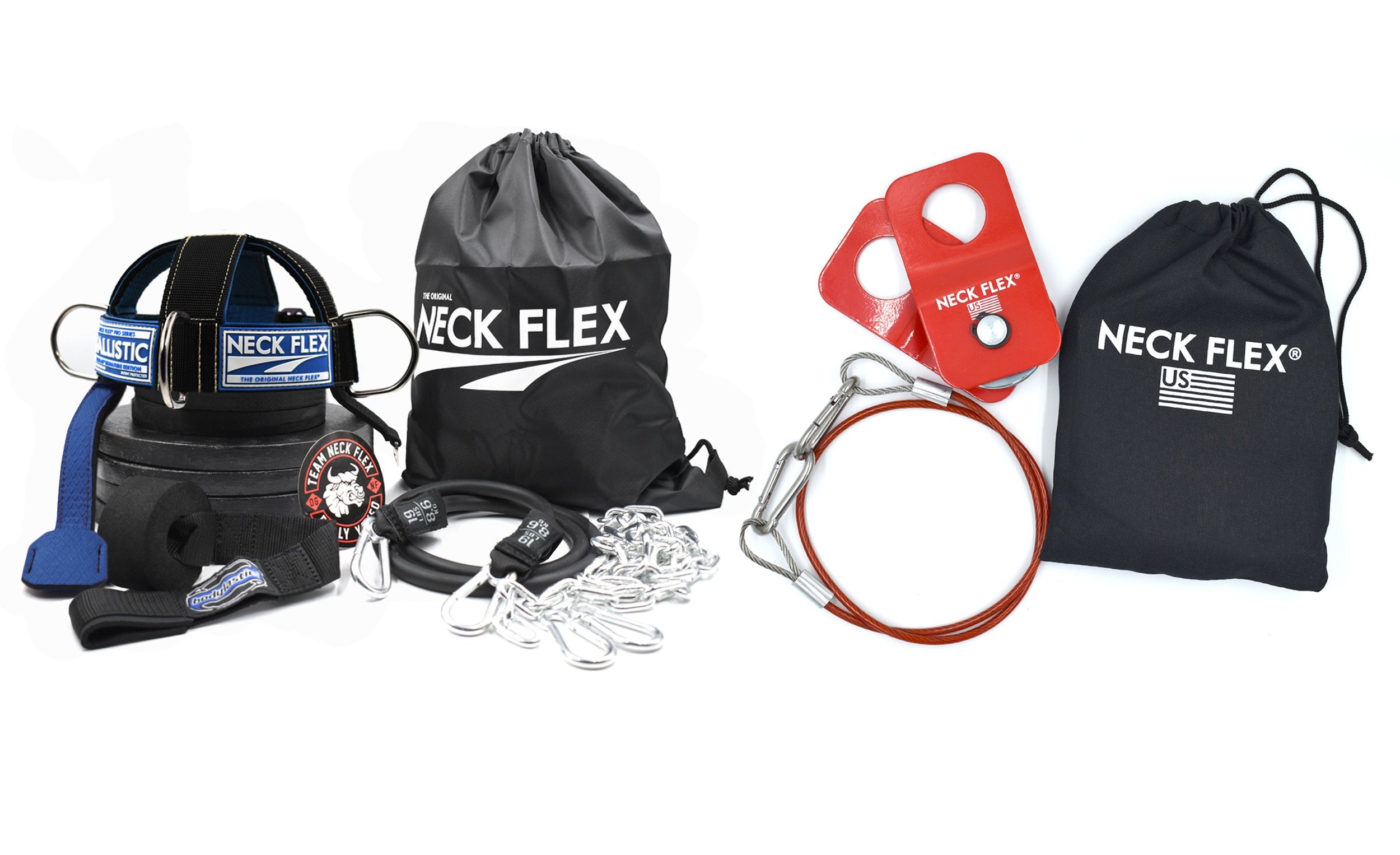
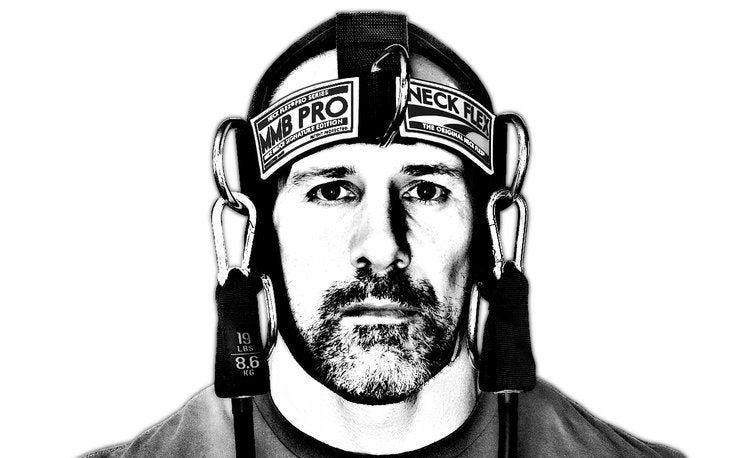
Neck Flex® MMB Pro Series Kit — plate-loaded, four steel D-rings, Mike Bruce Signature Edition, rated to 300 lb working weight. Neck Flex® Ballistic Kevlar® Series Kit — Kevlar®-stitched, rated to 300 lb working weight. Both ship complete with loading chain, Bodylastics® band, door anchor and tote.
Frequently asked questions
Is neck training safe? Yes, with a harness that has been tested. Every load-bearing part of the Neck Flex held at least 749 lbf at NC State.
How much weight can a neck harness hold? A Neck Flex is rated to 300 lb of working weight (lifting, moving, swinging, twisting); its D-rings held 819–937 lbf each and its fabric 1,156–1,461 lbf.
Who performed the testing? The Physical Testing Laboratory of the Zeis Textiles Extension at North Carolina State University's Wilson College of Textiles, Raleigh, North Carolina. Report dated October 2, 2026.
What standard was used? A modified ASTM D5035 strip test on an MTS Criterion Model 43 at 12 in/min with a 10 kN load cell. D-ring specimens were loaded through a steel hook fixture.
What is the Neck Flex rated to? 300 pounds (136 kg) of working weight (lifting, moving, swinging, twisting, etc.) for both the MMB Pro and Ballistic Kevlar® harnesses. The chain loads both steel D-rings; the weakest ring held 749 lbf, so the pair carries about 1,500 lbf, and 300 lb is one-fifth of that.
Did the stitching fail? No. In every seam test on both harnesses the fabric tore at the seam line while the stitching held.
What failed first? At the loading points, the welded steel D-ring opened — at 819 to 937 lbf — with the webbing and stitching intact. On one MMB Pro pull the laboratory's steel hook fixture broke before the harness.
Where is the full report? Download the PDF.

